
A new report published by Iran’s Shana news agency on 18 October 2026 at 13:27 Iran time says Region 7 of the country’s gas transmission operations achieved more than IRR 153 billion in economic benefits from 23 employee proposals. The same update describes a 60 kW solar installation at the Hamedan operations centre, a fitness-for-service assessment on a 30-inch pipeline and repairs to seven industrial valves. These are management-reported outcomes, not independently audited savings.
For an industrial audience, the story connects three practical disciplines: pipeline integrity, maintenance cost control and local renewable generation. Crucially, economic benefits, installed power capacity and measured energy savings are different indicators. Treating them as interchangeable would exaggerate what the published information establishes.
What did the Region 7 manager announce?
Jalil Basiri Parsa, the Region 7 operations manager, told Shana that 23 suggestions implemented through an employee participation programme had generated IRR 153 billion in economic value. Shana did not publish the benefit attributable to each proposal, the calculation period, reference prices or verification method. Dividing the headline total by 23 would produce only an arithmetic average, not a defensible valuation of individual initiatives.
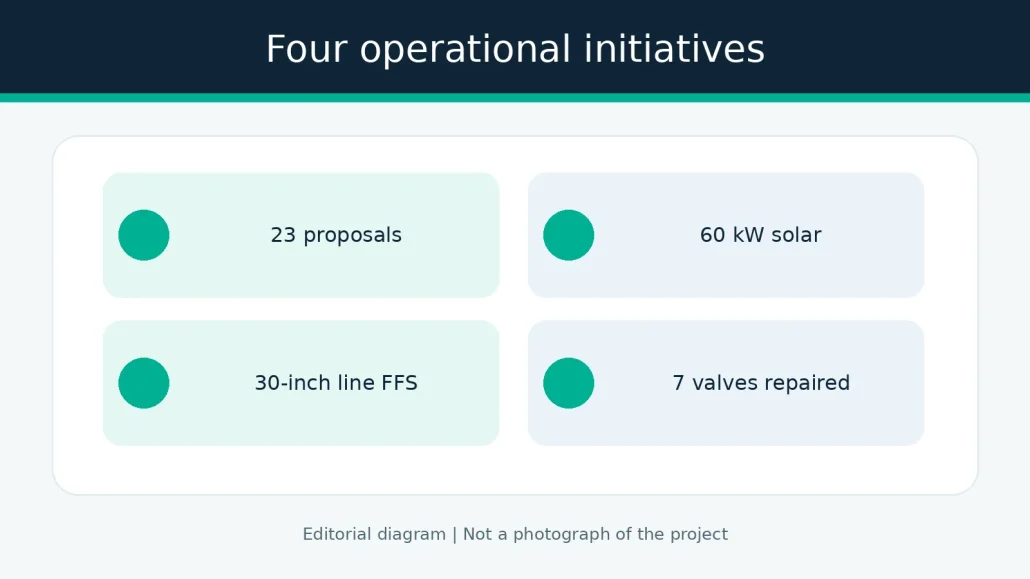
Four technical measures stand out: construction of a 60 kW solar facility in Hamedan; a change in calibration and linearisation work for data from Iran’s ninth national gas transmission line using a method described as spatial programming; an FFS assessment at the crossing of the 30-inch western pipeline and the Qomrud River; and leakage repairs on seven blowdown and bypass valves without replacing the complete valve assemblies.
How should the IRR 153 billion figure be interpreted?
An economic benefit may arise from avoiding replacement equipment, reducing downtime, removing unnecessary work or preventing an otherwise planned depressurisation and restart. None of those is automatically equivalent to a measured reduction in natural-gas consumption. For example, the value of avoiding a replacement should be assessed against a documented counterfactual, including the alternative engineering work, inspection and residual risk-management costs.
The importance of a credible baseline
An auditable assessment would identify what expenditure would actually have occurred without the proposals, the relevant equipment quantities and prices, the implementation cost and whether the benefit is one-off or recurring. The news item does not provide these inputs. The IRR 153 billion figure should therefore remain explicitly attributed to the regional manager rather than presented as independently certified financial performance.
A 60 kW solar installation at the Hamedan operations centre
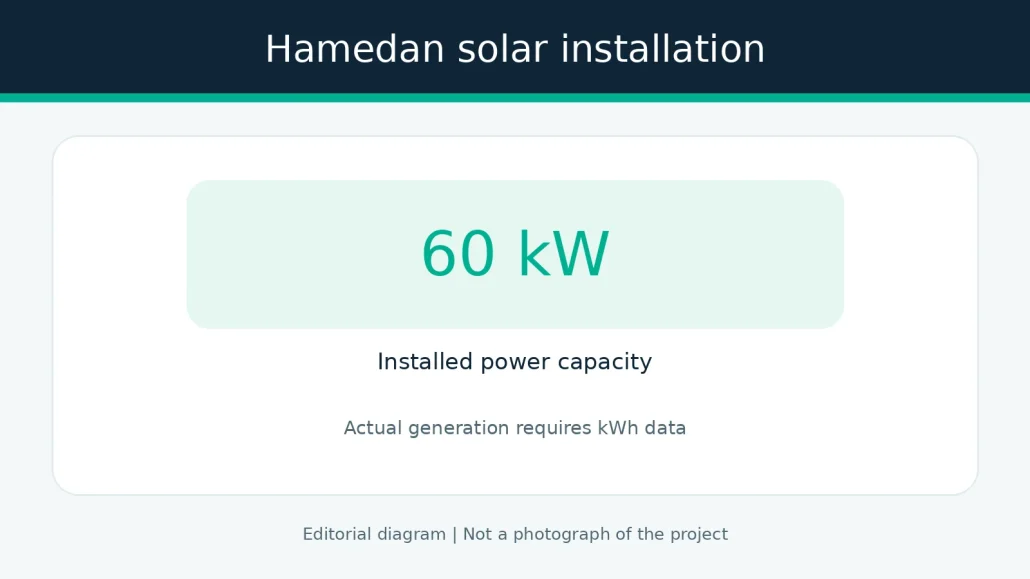
The manager also reported a 60 kW solar power installation at the Hamedan operations centre. Kilowatts express nominal power, while electricity generated over time is recorded in kilowatt-hours. Actual output depends on solar irradiation, temperature, inverter performance, system availability and operating conditions. No annual production figure was disclosed in the source.
To evaluate this project, an operator would need a generation meter, records of electricity purchased from the grid and a clear distinction between site demand and onsite generation. Installed capacity alone cannot establish the reduction in an electricity bill or carbon emissions. The Hamedan location makes the initiative locally relevant, but Shana does not identify a manufacturer of any metering equipment installed there.
Fitness-for-service assessment of the 30-inch western pipeline
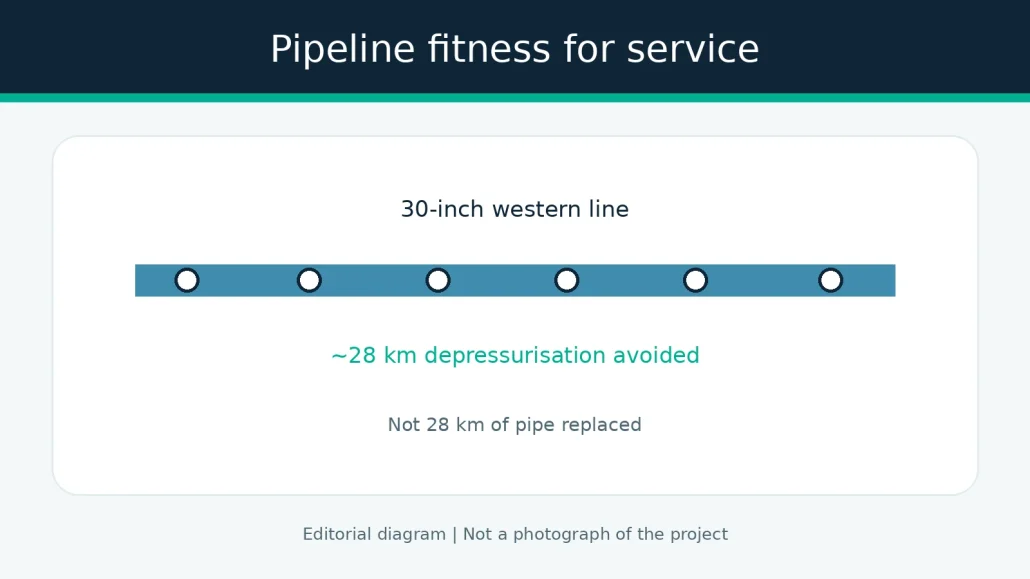
According to the Region 7 manager, an FFS assessment near the Qomrud River crossing helped avoid replacing part of the 30-inch western line and depressurising approximately 28 km of pipeline. The distinction matters: the reported outcome is avoidance of a replacement and depressurisation operation. It does not mean 28 km of pipe was replaced, nor does it quantify gas that might otherwise have been vented.
What decisions does FFS support?
Fitness-for-service assessments evaluate whether equipment with known flaws can continue operating within defined constraints. The established API 579-1/ASME FFS-1 framework supports run, repair or replace decisions for pressure equipment. However, Shana does not specify which standard, assessment level or inspection dataset was used in this particular project; assigning a specific procedure to the project would be speculative.
A positive engineering assessment does not remove the need for future inspection. Wall-thickness data, damage mechanisms, pressure and temperature limits, documented assumptions and follow-up monitoring remain central to integrity management. The report gives neither a detailed cost of the avoided work nor a measured gas volume associated with the avoided depressurisation.
Repairing seven leaking blowdown and bypass valves
Shana also reports that leakage was addressed on seven blowdown and bypass valves without full valve replacement. This may reduce spare-parts expenditure, outage duration and the scope of maintenance interventions. But an actual gas-loss reduction requires a suitable measurement method and comparable leakage rates before and after repair; those values were not published.
A sound maintenance record should identify each valve, its location and operating pressure, the leak-test method, repair date and post-repair acceptance result. Such records can reveal recurring failure modes and support risk-based maintenance. A count of seven repaired valves, by itself, is not a measured emissions-reduction metric.
Spatial programming for ninth national pipeline data
The report says a conventional calibration and data-linearisation approach for the ninth nationwide transmission line was replaced by a technique described as “spatial programming,” improving operational speed and accuracy. It does not disclose the algorithm, input data, verification protocol or percentage improvement. Accordingly, the term should be reported as used by the source, without inventing software architecture or metrology specifications.
Where gas metering and energy management fit
Transmission-system performance relies on dependable flow, pressure, temperature and data-quality measurements. At customer premises, a gas meter or smart gas meter records consumption and may support demand analysis. These are different applications: residential or commercial metering does not replace specialist pipeline inspection or high-capacity custody-transfer instrumentation.
Four useful indicators for future reporting
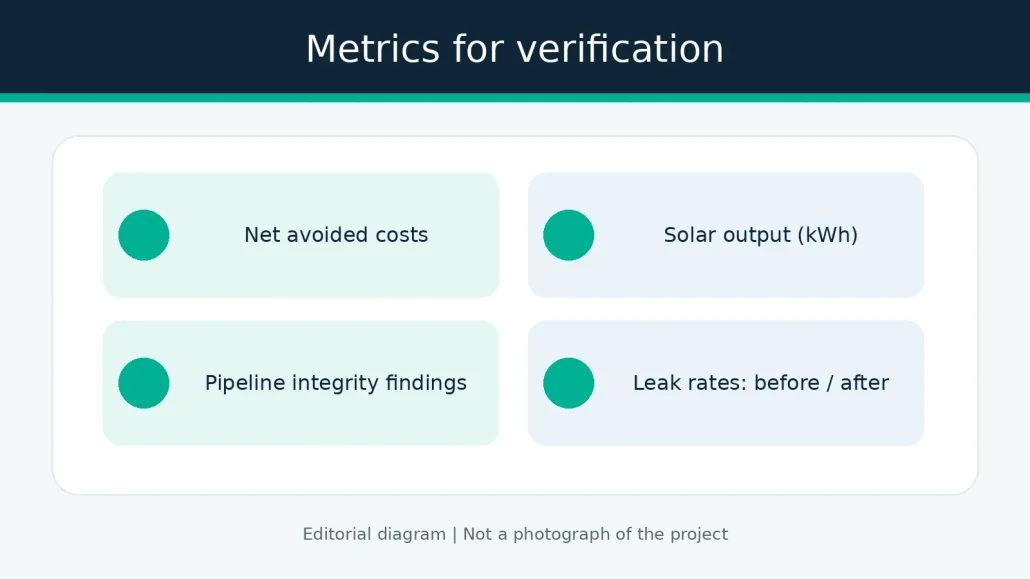
Follow-up coverage would benefit from four groups of figures: net avoided costs after proposal implementation expenses; measured solar electricity generation in kWh; the integrity assessment outcome and any operating restrictions for the 30-inch line; and measured valve leakage before and after repair. A defined measurement boundary, reporting period and baseline are needed for meaningful comparisons.
Conclusion
Region 7 offers a concrete example of employee-led process improvement combined with asset integrity and energy management in Iran’s gas transmission system. The IRR 153 billion amount is a reported economic benefit; 60 kW is installed solar capacity; and 28 km is the approximate length of pipeline whose depressurisation was reportedly avoided. Keeping those quantities distinct makes the story more useful and avoids unsupported claims about actual gas savings.
Frequently asked questions
What does the reported IRR 153 billion represent?
The Region 7 manager attributes this economic benefit to 23 employee proposals. The report does not disclose a project-level cost model or independent audit.
Does 60 kW mean 60 kWh of annual electricity generation?
No. The 60 kW figure is installed power capacity; actual electricity generation is measured in kWh over a defined period.
Was 28 km of pipeline replaced?
No. Shana says an FFS assessment helped avoid pipeline replacement and the depressurisation of approximately 28 km of line.
What is a fitness-for-service assessment?
FFS is an engineering evaluation of whether equipment with identified damage can remain in service under defined conditions, subject to appropriate inspection and controls.
Can the seven valve repairs be translated into a gas saving?
Not from the published figures. The report provides neither pre- and post-repair leakage rates nor a quantified emissions reduction.
Did Ekbatan Gas Control supply equipment for this project?
The news report does not identify any gas meter manufacturer or model, so no supplier claim can be substantiated.
Sources and evidence limits
Primary source: Shana, 18 October 2026, 13:27, report 3057057. Technical context: American Petroleum Institute material on API 579-1/ASME FFS-1. General energy-performance verification context: SEP 50001 measurement and verification resources. None of these sources supplies a project-level independent financial audit of Region 7.
Shana — Region 7 report | API — Fitness for Service | SEP 50001 — M&V