
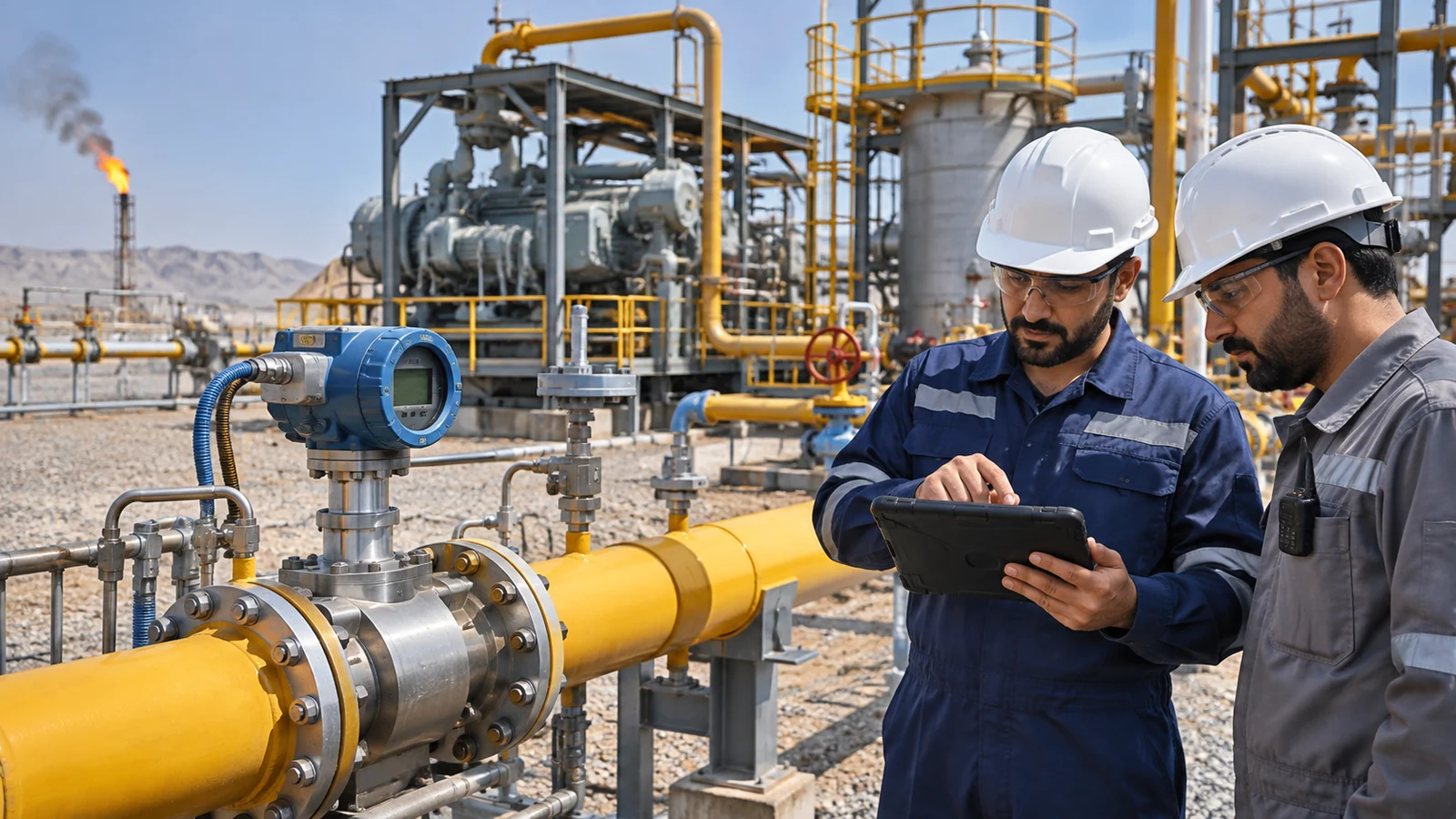
Associated gas is produced alongside crude oil. Depending on its composition, location and the availability of processing infrastructure, it may be recovered as fuel or industrial feedstock. Where suitable infrastructure is missing, some of the stream may instead be sent to a flare. Recovering associated gas therefore involves more than environmental protection: it affects resource efficiency, the security of energy supply, investment decisions and the accuracy of industrial measurement.
On 31 October 2026 (9 Aban 1405), at 10:28 local time, Iran’s official petroleum news agency Shana reported comments by Mohammad Bahrami Seyfabad, a member of parliament’s Energy Commission. He called for faster implementation of associated-gas recovery projects under the Seventh Development Plan and stronger private-sector participation. He mentioned activities in parts of Khuzestan, including Behbahan and Rag-e Sefid, where some gas has been directed to processing facilities. The report does not announce a newly signed contract, a verified incremental recovery volume or a new meter procurement. <a href="https://www.shana.ir/news/3160428/” rel=”noopener noreferrer”>Official Shana source.
What the 31 October report confirms
The news item identifies associated-gas recovery as a legal development-plan priority and describes its potential contribution to industrial feedstock supply and reduced resource waste. It also notes financing constraints, technical challenges and the possible role of private investors. These are statements about policy and project direction, not an audited performance report for every Iranian oil field.
Policy, implementation and verified output are different
An intention to expand private participation is not the same as an awarded contract. Similarly, mentioning recovery activities in Behbahan or Rag-e Sefid does not provide the gas volume recovered over a specified period. A credible technical article must separate announced objectives, completed engineering works and independently verified operating data.
Why the issue matters during the heating season
Gas that can be processed and delivered reliably may support industrial supply and the broader gas balance. But associated gas cannot automatically be injected into residential distribution networks. Its quality, pressure, processing requirements, transportation capacity and contractual delivery conditions must first be established.
What is associated gas?
Associated gas occurs with crude oil in the reservoir and separates from the liquid as production conditions change. Its composition can vary significantly between fields and over time. The stream may contain methane and heavier hydrocarbons, water vapour and other constituents requiring treatment before delivery to a buyer or consumer.
Associated gas, flare gas and pipeline gas
These terms describe different characteristics. Associated gas refers to origin; flare gas refers to a stream directed to a combustion system; pipeline-quality gas must meet specified delivery requirements. A field may recover part of its associated gas, use part as on-site fuel and flare another part during routine or abnormal operations.
Why some flares remain necessary
A flare can be an essential safety system during pressure relief, emergency shutdown or abnormal process conditions. Recovery projects seek to reduce avoidable routine flaring, not to remove necessary protective equipment. Safety-system modifications require engineering design, risk assessment and authorization.
How an associated-gas recovery project works
The engineering sequence begins with characterizing the flow. The project team then evaluates liquid separation, possible sweetening and dehydration, compression, transfer and the final use of the gas. A solution that works near an existing gas-processing plant may not be economic for a remote field with highly variable flow.
Flow measurement and gas sampling
Engineers need time-resolved flow data, pressure, temperature, gas composition and records of production interruptions. Inadequate inlet data can lead to incorrectly sized compressors and pipelines and unreliable investment projections. The quality of the baseline is as important as the sophistication of the equipment.
Processing and compression
Liquid removal and other treatment may be required before the gas can be transported or used. Compression may be needed to achieve delivery pressure. Power consumption, maintenance requirements and equipment availability should be included in lifecycle assessments; recovered gas volume alone does not describe net project performance.
Selecting the destination
Potential destinations include processing facilities, petrochemical plants, industrial fuel systems, on-site electricity generation and transmission networks when quality requirements are met. The preferred option depends on location, gas quality, demand reliability, safety and economics.
Associated-gas recovery is not the same as distribution leakage reduction

Recovery projects address gas streams produced in upstream oil operations. Leakage reduction addresses losses from pipes, joints, regulators and metering installations elsewhere in the supply chain. Both can improve resource management, but they require different measurement boundaries, engineering practices and performance indicators. Their reported savings should not be added without checking for double counting.
The proper role of gas regulators
A gas regulator maintains pressure within its designed operating envelope. Industrial applications require selection based on inlet and outlet pressure, flow, gas composition and applicable standards. A residential G4 diaphragm gas meter or household regulator is not a substitute for high-pressure associated-gas flow measurement and control equipment.
Reliable metering is essential
A recovery plant needs to know how much gas enters, how much is consumed by processing, how much is delivered and how much continues to be flared. Without consistent measurements, project efficiency and contractual settlement remain uncertain. Meter selection, calibration and data governance must therefore be designed into the project from the outset.
What should be measured?
Key variables include volumetric or mass flow, temperature, pressure, gas composition, compressor status and downtime. Standardized reference conditions must be stated whenever gas volumes from different locations are compared. Differences between operating and standard volumes are not automatically physical losses.
Industrial flowmeter selection
There is no single meter technology suitable for every composition, pressure and flow range. Engineers evaluate accuracy, turndown, pressure loss, contamination tolerance, installation constraints and calibration. Selecting a meter solely on purchase price can increase long-term uncertainty and operating cost.
Calibration and traceability
Measurement uncertainty, calibration history and inspection schedules should be documented. Data generated outside a meter’s validated operating range may appear precise but be misleading. Projects involving multiple parties also need an agreed custody-transfer methodology.
Digital monitoring, AMR and operational data
Remote monitoring can improve visibility of flow trends, pressure changes, equipment trips and abnormal conditions. AMR generally refers to automated meter reading, while AMI often denotes a broader communication and data-management infrastructure. The exact functions must be defined for each installation rather than inferred from a marketing label.
Are residential smart gas meters used directly at oil-field flare lines?
No. A smart residential gas meter or an upgraded gas meter is designed for a particular downstream operating envelope. Industrial upstream flow measurement needs equipment qualified for its own pressure, gas properties and safety conditions. The relevance of smart metering to recovery is chiefly the broader value of trustworthy, timely data throughout the gas chain.
Turning data into action
A dashboard does not reduce flaring by itself. Useful monitoring links measured deviations to alarms, maintenance plans, responsible personnel and documented corrective action. Operators should distinguish planned shutdowns from equipment failures when assessing availability.
How should recovered gas and avoided flaring be calculated?

A credible assessment first defines the measurement boundary: gas produced, gas entering the recovery plant, gas consumed internally, gas delivered and gas still flared. “Collected gas”, “saleable gas” and “avoided flare gas” are not interchangeable quantities.
A hypothetical calculation
Suppose a facility receives 100,000 standard cubic metres of associated gas during one day and delivers 80,000 standard cubic metres after processing. The second number is the day’s delivered volume if measurement conditions are consistent. It does not, by itself, prove that flaring fell by 80,000 cubic metres compared with the pre-project baseline. These numbers are illustrative and do not refer to any Iranian field.
Accounting for oil-production changes
Associated-gas production can change with oil output, reservoir pressure and process conditions. A rise in recovered volume might reflect higher production rather than improved recovery efficiency. Comparisons should use equivalent periods and suitable normalization factors.
Private-sector participation and project economics
Private investors may contribute engineering, equipment, finance, operation and maintenance. Contracts should define gas ownership, delivery points, quality responsibility, performance guarantees and risk allocation. The 31 October Shana report does not specify a universal contract model or announce individual new tenders.
Beyond equipment capital expenditure
A realistic business case includes civil works, electricity, processing, transmission, safety systems, spare parts, maintenance and downtime. Low-flow scenarios and variable gas quality can materially affect economics. Profitability cannot be responsibly asserted without field-specific data.
Useful performance indicators
Possible indicators include standard-condition delivered gas, plant availability, quality compliance, energy consumed per unit of gas delivered and repair response time. Every indicator needs a defined method, reporting period and accountable verifier.
Effects on Iran’s gas balance and energy efficiency
Recovering usable associated gas may support industrial feedstock supply and reduce avoidable waste. However, the benefit depends on actual capacity, gas quality and access to delivery infrastructure. It is not automatically equivalent to an identical increase in winter household supply. Demand-side efficiency, network reliability and storage remain separate parts of the energy balance.
Environmental performance requires lifecycle assessment
Routine flaring may generate emissions, but estimating avoided emissions requires the gas composition, combustion conditions, leakage, processing energy and final use to be considered. If recovered gas is subsequently burned elsewhere, that downstream combustion cannot be ignored. No precise emissions-reduction percentage follows from the Shana announcement alone.
Opportunities for Ekbatan Gas Control

For Ekbatan Gas Control, the most relevant connection is expertise in gas measurement and downstream data systems, not a claim that a residential meter can be installed on an upstream flare line. Residential gas meters, smart gas meters, upgraded meters, remote reading and gas regulators serve defined market segments and operating conditions.
Interoperable downstream measurement data
Standardized data exchange, time-stamped readings and quality checks may help downstream operators understand consumption patterns and assess efficiency measures. Integration with industrial platforms requires separate cybersecurity, reliability and engineering reviews.
Clear product boundaries
G1.6, G2.5, G4 and G6 meters must be used within their rated applications. Entry into upstream industrial flow metering would require independent technical qualification, appropriate standards, hazardous-area assessment and testing capabilities. The cited report does not establish an order, tender or supply contract for Ekbatan.
Frequently asked questions
What is associated gas?
Gas produced together with crude oil and separated during production. Its composition varies between fields.
Why is associated gas flared?
Infrastructure limitations, processing constraints, variable production or safety requirements may lead to flaring. Each field requires its own assessment.
Did the 31 October 2026 report announce a new contract?
No. It discusses accelerating projects and private-sector participation without announcing a specific newly awarded contract or recovery volume.
Can associated-gas recovery solve Iran’s gas imbalance?
It can contribute to supply and reduce waste, but the scale depends on deliverable volume, quality, infrastructure and demand. It is not a complete solution by itself.
Can untreated associated gas enter a residential network?
Not necessarily. Gas must meet applicable quality, pressure and safety requirements, often after processing.
Is a G4 household meter suitable for a flare-recovery pipeline?
No. High-pressure industrial streams require flowmeters qualified for the relevant conditions.
Do smart gas meters automatically reduce consumption?
No. They can improve visibility and remote reading; savings depend on technical and operational changes.
What data are needed to verify avoided flaring?
A documented baseline, before-and-after flows, production changes, reference conditions, downtime and delivered or used volumes.
Conclusion
The Shana report of 31 October 2026 highlights associated-gas recovery as a priority under Iran’s Seventh Development Plan and points to a stronger role for private-sector participation. The practical value lies in turning potentially wasted gas into usable energy or industrial feedstock. Yet reported intentions must not be confused with measured output or signed contracts. Sound projects require realistic engineering, finance, a defined delivery destination, calibrated industrial metering and transparent verification. Across the wider gas industry, from upstream custody-transfer meters to downstream smart meters, reliable data underpins credible energy-efficiency decisions.
Primary Iranian source: Shana, 31 October 2026, report 3160428: https://www.shana.ir/news/3160428/