
When gas losses in a network are discussed, leaking pipes and connections are often the first things that come to mind. Yet a difference between gas received and consumption recorded in customers’ bills does not necessarily represent a physical leak. Unaccounted-for gas, or UFG, is a measurement and energy accounting issue that can result from a combination of technical, commercial, timing and data-related factors. Distinguishing them has practical importance for gas companies, network operators and manufacturers of metering equipment.
This guide is intended for Ekbatan Gas Control’s professional readership. It explains the definition and conceptual gas balance equation, then examines possible causes of discrepancies, investigation priorities, monitoring indicators and the role of gas meters. All numerical examples are educational. None is presented as actual UFG statistics for Iran or as evidence of the performance of Ekbatan products.
What exactly does unaccounted-for gas mean?
Unaccounted-for Gas normally describes the residual difference after gas entering a defined system boundary is reconciled with recorded outputs and authorised balance items. Contractual definitions and calculation methods can differ between networks and accounting systems. Before comparing two provinces or reporting periods, the network boundary, volume basis, time period and adjustments must therefore be aligned.
Simply subtracting billed gas from the gas delivered into the network can incorrectly classify authorised operational consumption, changes in gas stored in pipelines, reading-time differences and incomplete data as losses. A raw discrepancy is therefore different from an adjusted UFG figure that can be analysed meaningfully.
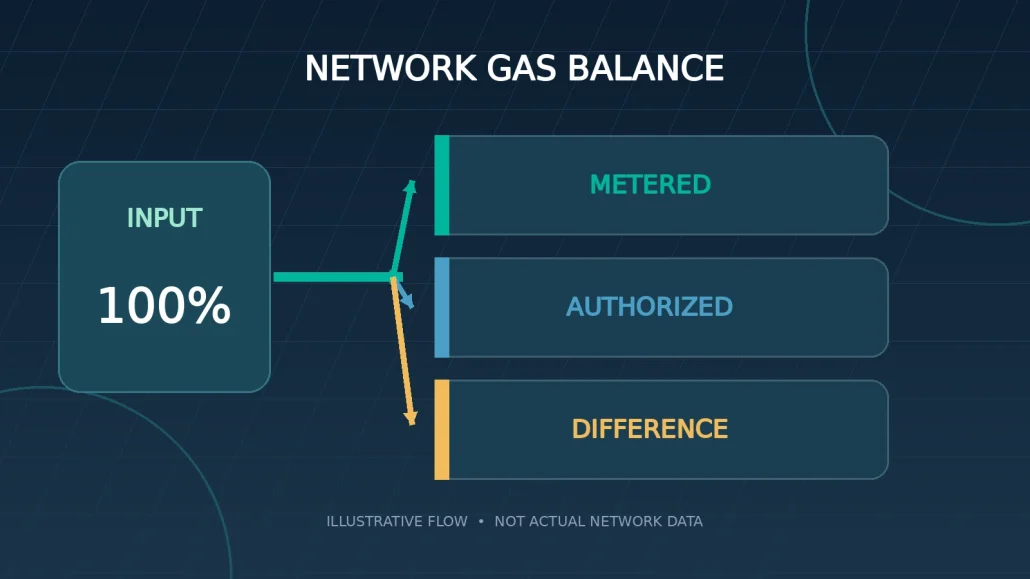
A simple relationship for understanding the balance
Conceptually: Residual discrepancy = gas input − recorded gas outputs − recorded authorised consumption ± timing and network inventory adjustments. The sign of the adjustments depends on the calculation convention. This relationship is educational and does not replace the operator’s approved procedures, a mass or energy balance, or applicable calculation standards.
Why does accurate measurement matter for reducing UFG?
A gas balance depends on data quality on both sides of the equation: input measurement at stations and consumption measurement at outlets or customer premises. A small systematic error at a high-throughput point can affect the aggregated volume. Reading errors affecting many customers can also produce a substantial discrepancy over a reporting period. Identifying a cause requires knowing which device recorded the data, over what interval and under which conditions.
Gas meters must be selected for the operating flow range, pressure range, environmental conditions, gas characteristics and legal requirements. Measurement validity is not determined by meter technology alone. Appropriate sizing, installation in accordance with instructions, authorised periodic testing, intact seals and correct equipment identifiers are also important. A meter does not automatically have lower error or leak detection capability simply because it is smart.
Four main groups of gas balance discrepancies
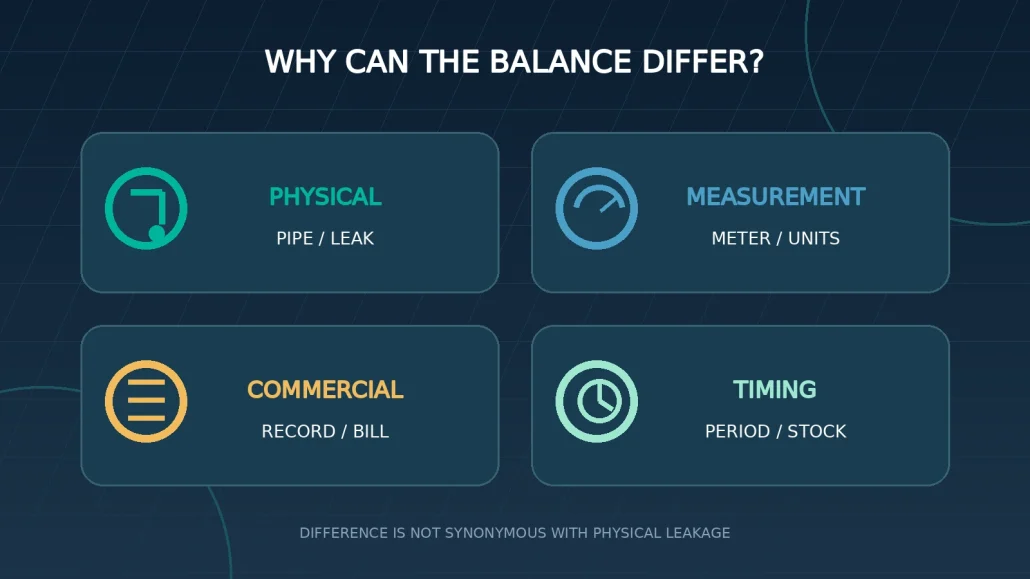
| Factor group | Possible examples | Initial investigation |
|---|---|---|
| Physical | Leaks in pipes, connections or equipment | Pressure monitoring, maintenance records and authorised leak surveys |
| Measurement | Incorrect sizing, meter error or different volume bases | Specification review, authorised testing and unit harmonisation |
| Commercial and data-related | Incorrect identifiers, incomplete readings or unauthorised connections | Reconcile customer records and readings; conduct lawful inspections |
| Timing and operational | Asynchronous readings, linepack changes or authorised consumption | Align reporting periods and examine adjustment items |
1٫ Physical losses and operating conditions
Leaks from pipelines and equipment are one possible cause of discrepancies and are independently important for safety and the environment. Their volume cannot, however, be inferred from a gas balance discrepancy alone. Detecting and locating leaks requires specialised instruments and methods, compliance with safety requirements and action by the operator’s authorised personnel. If gas is smelled, official safety instructions and emergency procedures must be followed. Meter data do not replace emergency action.
2٫ Measurement error and differences in the volume basis
Gas is compressible, so temperature and pressure affect the reported volume. Comparing volumes at operating conditions with volumes converted to reference conditions can create an apparent discrepancy unless the bases are harmonised. Not every meter model performs temperature or pressure correction internally. Its output type, measurement unit and the presence or absence of correction equipment must be checked against that model’s technical documentation.
If actual demand remains near the lower end of a meter’s operating range for long periods, or exceeds its permitted range, its sizing and specifications need examination. Conclusions about actual error require valid testing that also takes measurement uncertainty into account.
3٫ Commercial discrepancies, readings and customer records
Incorrect serial numbers, mixed-up customer identifiers, estimated or missing readings, unrecorded equipment changes and billing delays can affect a periodic balance. Tampering or unauthorised connections may also be suspected in some cases. Establishing an infringement nevertheless requires valid documentation, lawful inspection and respect for the customer’s rights. An unusual consumption pattern alone does not prove wrongdoing.
4٫ Reading synchronisation and gas inventory in pipelines
If an input station is read at the end of the month while customer readings are collected on different days, the figures do not necessarily cover the same interval. Changes in network pressure can also alter the gas stored in pipelines, known as linepack. Daily or monthly comparisons may be misleading if this is ignored. Quantifying the adjustment requires reliable operational data and a valid model.
Educational calculation: why the raw discrepancy is insufficient
Assume a hypothetical area receives 1,000,000 m³ of gas during a month and bills 960,000 m³. The raw difference is 40,000 m³, or 4% of input. Now suppose 10,000 m³ of authorised operational consumption has been recorded and net timing and inventory adjustments explain another 5,000 m³ under this example’s accounting convention. The remaining discrepancy is then 25,000 m³, or 2.5% of input.
These figures are invented solely to explain the calculation. Even the remaining 2.5% does not mean 2.5% leakage. Determining the contribution of each factor requires spatial analysis, data checks and technical investigation. Without estimating input uncertainties, small percentage changes should not automatically be interpreted as improved or deteriorating performance.
How can a practical UFG monitoring programme be designed?
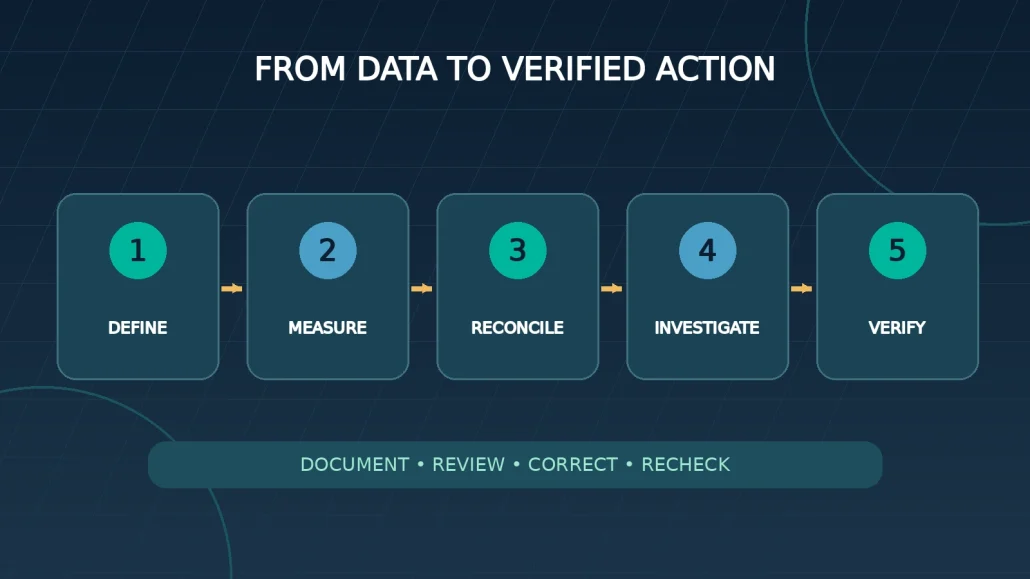
- Define the balance boundary: specify the geographical area, input and output stations, pressure level and reporting period.
- Put data on a common basis: record volume units, reference conditions, reading times, equipment identifiers and data versions.
- Assess data quality: flag missing, duplicated, estimated and invalid readings separately.
- Break down the discrepancy: examine documented adjustments and data errors first, then plan inspections for high-risk areas.
- Verify the result: following corrective action, recalculate the balance for comparable periods, accounting for uncertainty.
A pilot area with dependable measurement points is a sensible starting point. Whole-network totals help track trends, but identifying causes generally requires breakdowns by area, station, customer class or pressure level. Comparisons with the same period of the previous year also need to account for temperature, customer numbers and changes in consumption patterns.
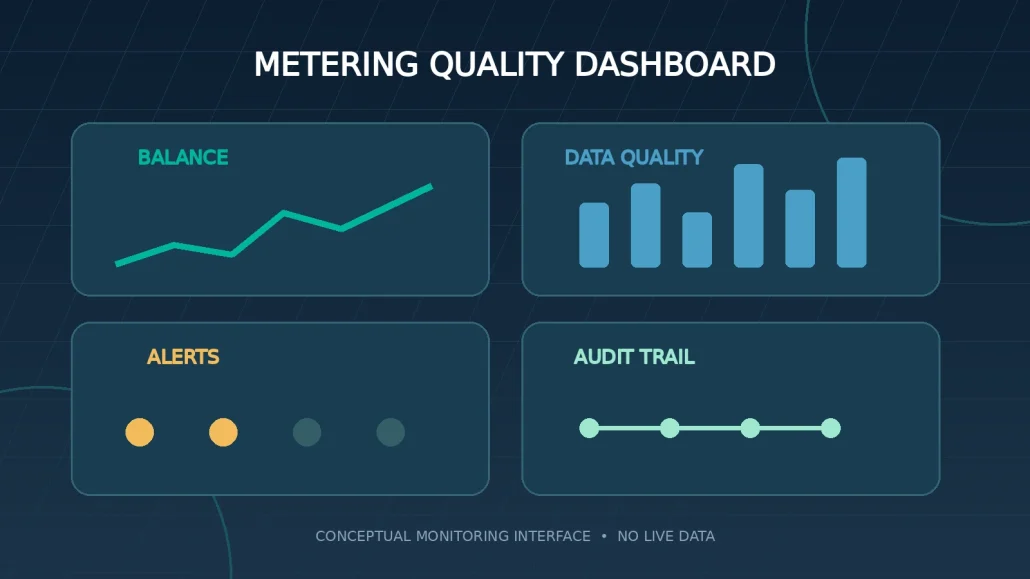
Key indicators for a gas balance monitoring dashboard
| Indicator | Use | Interpretation limit |
|---|---|---|
| Raw discrepancy rate | Difference between input and recorded output relative to input | Without adjustments, it is not a leakage indicator |
| Incomplete data rate | Missing or estimated readings as a share of the total | Measures data quality, not physical loss |
| Equipment testing coverage | Share of applicable equipment with valid testing status | Test results and appropriate installation also matter |
| Discrepancy resolution time | Time between an alert and a documented resolution | A fast decision is not necessarily correct |
| Adjusted discrepancy | Residual after documented balance items | Depends on calculation methodology and uncertainty |
Every dashboard figure should identify its system boundary, reporting period, validation status and responsible reviewer. A professionally presented graph without an explanation of its measurement basis is not dependable for operating decisions. Customer data also need protection through role-based access, minimisation of identifying information and access logs.
What role can smart meters play?
Where a model and its supporting infrastructure have verified capabilities, remote reading can reduce collection delays and make consumption trends easier to analyse. Time-stamped event records and automated data quality checks may also accelerate discrepancy detection. Reliable communications, cybersecurity, compatible information systems and human review processes remain essential for turning data into effective action.
One smart system may only transmit readings, while another provides additional functions. Tamper alerts, remote shut-off, instantaneous measurement and leak detection should therefore not be assumed for every smart meter. For Ekbatan Gas Control products, any capability claim must be supported by the relevant model’s datasheet and valid certification.
Why does the issue matter for Iran’s gas industry?
An interview with the managing director of Khuzestan Gas Company, published on 30 Mordad 1405, emphasised monitoring gas balances by area, station and pressure level, evaluating measurement equipment and avoiding unverifiable statistics. Published as a report attributed to Shana, it provides real context for attention to UFG in Iranian distribution networks. It does not provide a basis here for deriving a verified national or provincial UFG rate.
A Tasnim report dated 4 Shahrivar 1405 described a first-phase target to manufacture and install approximately 450,000 residential smart meters. This is an announced project target, rather than a confirmed installation total. Its relevance to UFG lies in the potential opportunity to improve data quality, rather than evidence that losses have already fallen.
Practical suggestions for operators and manufacturers
For operators, the first priorities are an auditable gas balance and better data quality. For equipment manufacturers, documenting measurement ranges, operating conditions, installation requirements, traceable tests and data outputs supports correct selection and reliable maintenance. On both sides, an integrated record of meter serial numbers, installation dates, testing history and reading status provides a foundation for analysing real discrepancies.
UFG reduction projects should have explicit objectives, a valid baseline, a result measurement method and clear responsibilities. If a discrepancy falls only because the billing period changed or a software error was corrected, it should be reported that way. If a physical leak was repaired, operational and measurement evidence should be traceable. Making the distinction strengthens the confidence of decision-makers and customers.
Conclusion
Reducing unaccounted-for gas starts with a precise balance boundary, good measurement and traceable data rather than with an isolated number. An accurate meter suited to its application is one essential part of the chain. UFG management also requires safe operation, record keeping, technical analysis and verification. Considering equipment and data together can make efficiency decisions in Iran’s gas industry better documented and more defensible.
Sources and methodology
- Republication of Shana’s interview with the managing director of Khuzestan Gas Company, 30 Mordad 1405: gas balance monitoring and measurement quality.
- Tasnim, 4 Shahrivar 1405: first-phase target of 450,000 residential smart meters.
- Tasnim, 25 Khordad 1405: smart metering and equipment modernisation plans in Fars Province.
The technical sections and numerical examples are educational analysis. They must not be quoted as official national gas loss statistics or specifications of Ekbatan products. Dates above follow the Iranian calendar.
Frequently asked questions
Is unaccounted-for gas the same as gas leakage?
No. UFG is the residual difference in a gas balance and may result from leakage, measurement error, timing differences, incomplete data or commercial factors.
What is the UFG calculation formula?
The precise formula depends on the accounting convention and balance boundary. Conceptually, the residual is the gas input after recorded outputs, authorised consumption and documented adjustments have been accounted for.
Can a smart meter reduce UFG on its own?
No. Verified reading and data recording capabilities can improve analysis, but addressing the causes requires data infrastructure, investigation and corrective action.
Why do temperature and pressure matter?
Gas volume depends on measurement conditions. Comparing volumes recorded under different conditions without a valid conversion to a common basis can create an apparent discrepancy.
Does an unusual consumption pattern prove meter tampering?
No. It can justify further examination, but establishing an infringement requires lawful inspection and independent evidence.
What contribution can Ekbatan Gas Control make?
Metering equipment with documented specifications, correct selection, valid tests and information support can contribute to improving gas balance quality. Each product’s capabilities must be verified separately.