

Iran led the regional “Exercise Bravo – Caspian Sea 2026” oil-pollution response drill with participation from all five Caspian littoral states. The announcement was reported on 14 October 2026 (22 Mehr 1405), citing Iran’s Ports and Maritime Organization. The reported emphasis was on emergency notification, information exchange and requests for assistance under a simulated oil-pollution scenario—not on an actual spill or a verified offshore cleanup operation.
For the energy sector, this is more than an environmental news item. A response system depends not only on vessels and recovery equipment but also on timely, standardized information and clear responsibilities across borders. This article distinguishes official statements from engineering interpretation and does not attribute any role in the drill to Ekbatan Gas Control.
When did the Caspian exercise take place, and who participated?
According to Nader Pasandeh, director-general for maritime safety and protection at the Ports and Maritime Organization, the regional programme ran from 3 to 9 October 2026 (11–17 Mehr), with its operational exercise day on 5 October (13 Mehr). Iran hosted and coordinated the exercise; Russia, Azerbaijan, Kazakhstan and Turkmenistan took part. The 14 October news date must not be confused with the dates of the drill itself.
| Item | Reported detail | Editorial qualification |
|---|---|---|
| Exercise | Exercise Bravo – Caspian Sea 2026 | Simulated regional emergency |
| Period | 3–9 October 2026 | News published 14 October |
| Exercise day | 5 October 2026 | Not the date of an actual spill |
| Participants | Iran, Russia, Azerbaijan, Kazakhstan, Turkmenistan | Five Caspian coastal states |
| Reported focus | Alerting, information exchange, assistance requests | No verified cleanup performance figures |

What did the emergency scenario test?
The exercise used a hypothetical marine oil-pollution emergency. Iran established a timetable and issued a simulated assistance request through electronic correspondence and standardized pollution reports (POLREP). Participating states acknowledged receipt and supplied information about their readiness, equipment, facilities and potentially deployable response teams. This tests the regional communication chain; it does not establish that an oil slick was physically contained or recovered.
Communications exercise versus field deployment
A communications exercise asks who sends the alert, which format is used, who receives it and how the response is recorded. An offshore deployment adds vessel mobilization, containment booms, recovery systems, temporary storage, crew safety and weather limitations. The available announcement provides no verified counts of deployed vessels, lengths of boom, volumes recovered or actual mobilization times.
What is POLREP and why does it matter?
POLREP is a structured marine-pollution reporting format used in emergency communication arrangements. Standardized fields can reduce ambiguity about a possible incident’s location, pollutant, scale and required assistance. A completed form is not, by itself, proof that the underlying information is accurate or that a response will succeed.
The importance of traceable incident data
A well-designed response process records the observation time, location, suspected source, substance, preliminary extent, wind and current conditions, potential shoreline exposure and requested support, with uncertainty explicitly identified. These are general good-practice data elements, not a claim about every field in the specific form used in this exercise.
How does this connect to oil and gas infrastructure safety?
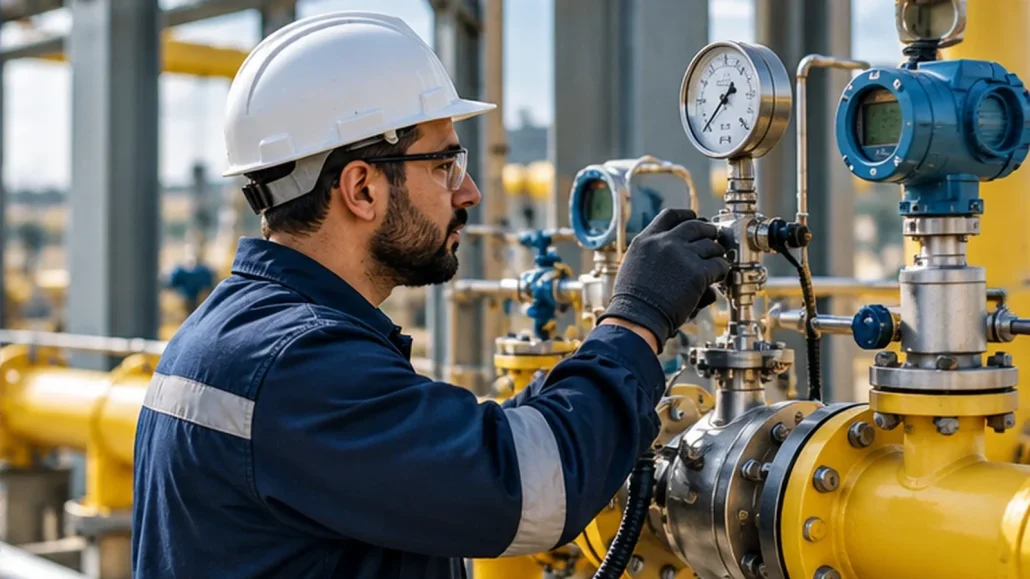
Marine pollution risk may arise in offshore production, transportation, loading, unloading and related storage operations. Prevention involves inspections, maintenance, pressure and flow monitoring, anomaly detection and operational controls. Emergency preparedness is a separate protective layer: if prevention fails, organizations must be able to coordinate containment and protect sensitive locations. Neither layer replaces the other.
Measurement quality and situational awareness
Reliable flow, pressure, tank-level and valve-status data may help operators identify abnormal process conditions and build a more accurate picture of an incident. However, offshore oil-spill surveillance is fundamentally different from residential gas metering. The relevance to Ekbatan Gas Control is the broader engineering principle of trustworthy measurement and data—not a reported involvement in the Caspian exercise or a claim that household gas meters detect marine spills.
How should the success of a regional drill be measured?
Completion of a drill is only the starting point. Useful performance indicators include time to issue an alert, time to acknowledge it, data completeness, response time by each participating authority, clarity of command, mobilization feasibility and closure of corrective actions. If physical deployment is performed, equipment readiness, crew safety and containment effectiveness should also be evaluated. The announcement did not publish numerical results for these indicators.
| Assessment area | Suggested metric | Purpose |
|---|---|---|
| Notification | Time from issue to acknowledgment | Identify communication delays |
| Data quality | Completeness and uncertainty flags | Avoid decisions based on assumptions |
| Coordination | Response time and designated lead | Reduce duplicated or conflicting action |
| Resources | Verified deployable capability | Distinguish nominal inventory from readiness |
| Improvement | Corrective actions and owners | Turn lessons into measurable changes |

Why cooperation among all five Caspian states matters
Marine pollution does not respect national boundaries. Wind, currents and environmentally sensitive coastlines create a practical need for cross-border coordination. Joint exercises provide an opportunity to test whether notification and assistance procedures work across agencies and jurisdictions. The Iranian announcement places the drill within the annual programme of the interim secretariat of the Tehran Convention. It does not report a new treaty, a newly approved funding programme or an equipment procurement agreement.
Declared capacity is not proven operational capacity
An inventory of available vessels and personnel helps planners, but actual readiness also depends on equipment condition, trained crews, permissions, logistics and operating weather. Participation by five states should therefore not be presented as proof that any scale of spill can be contained.
Practical lessons for energy-sector managers
Keep emergency contact trees and decision rights current. Require timestamps and traceable sources for operational data. Evaluate communications drills separately from field exercises, then test the two together. Assign owners and deadlines to every corrective action. In public reporting, distinguish the planned objective, the activity completed and the measured result. These practices apply beyond maritime incidents to other high-consequence industrial operations.
Frequently asked questions
Conclusion: the real test is coordinated readiness
The 14 October 2026 report confirms a regional simulated oil-pollution exercise led by Iran with participation from the other four Caspian coastal states. The disclosed actions primarily concern POLREP communication, assistance requests and readiness information. The exercise highlights the value of cross-border preparation, but without a published after-action assessment or measured response data, its operational effectiveness cannot be independently established.
Sources and editorial limitations
Report relaying the Iranian Ministry of Roads and Urban Development / Ports and Maritime Organization statement, 14 October 2026; report relaying Mehr News Agency coverage, 14 October 2026. Dates and participation are attributed to the official statement; operational metrics and engineering commentary are editorial analysis. All images are conceptual industrial archive visuals and do not depict the Caspian exercise.