

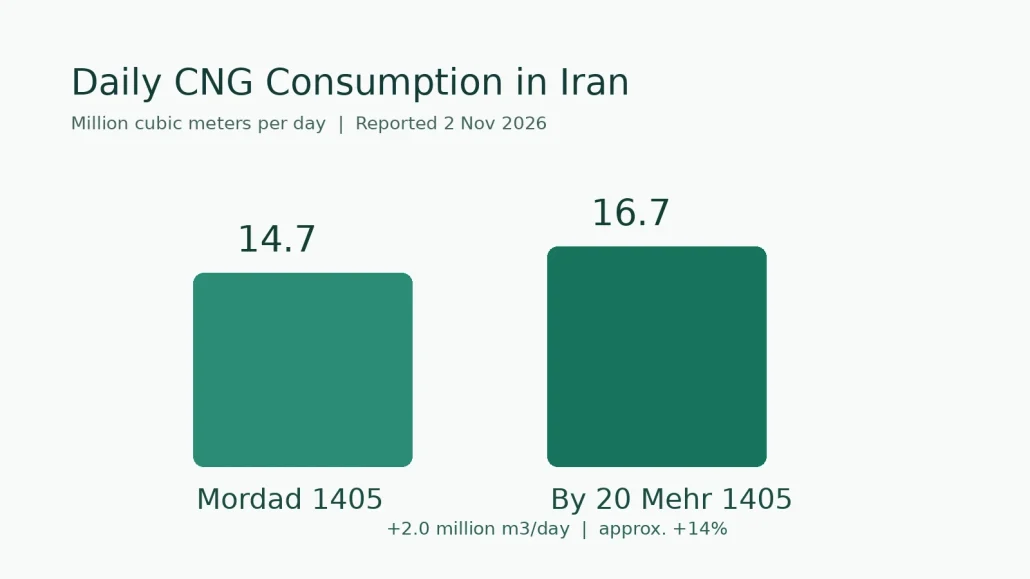
Shana reported on 24 October 2026 that daily compressed natural gas consumption rose from approximately 14.7 million cubic metres in August to 16.7 million cubic metres by 20 October 2026. The change was described as roughly 14 percent over that interval.
The industrial significance of this report is best understood by combining the verified facts with a careful review of measurement, operational limits and practical implementation. It should not be treated as a procurement notice or a record of achieved energy savings without additional evidence.
What the Iranian source establishes
The source can establish what an official or sector representative announced and when. It cannot, by itself, prove technical acceptance, commissioning, a new legal tariff or a measured change over a full annual operating cycle. Those require separate primary documentation.
Evidence and chronology
This article distinguishes the documented announcement from engineering interpretation. The source date is the date of the reported event, not the publication date of this editorial package. No new contract, national rollout, actual saving or tariff is inferred unless it is explicitly supported by a cited Iranian source.
Technical context and boundaries
The increase in CNG use may displace some gasoline demand, but it does not by itself prove a reduction in total primary energy use. High-pressure CNG dispensers and station metering have different operating and safety requirements from residential diaphragm meters.
Engineering interpretation
A useful technical assessment should identify the location of the measurement boundary, the physical state of the gas stream, the applicable safety and metrological requirements, and whether the reported quantity represents inventory, flow, capacity, consumption or merely a plan.

Measuring performance rather than assumptions
A defensible assessment starts with a clearly bounded system, a defined measurement period and traceable data. State who took the readings, which equipment was used, whether the readings were corrected for pressure and temperature, and how uncertainty was treated. Where the figures are forecasts or nominal capacities, label them as such.
Baseline and uncertainty
Even when the reported number is correct, its interpretation depends on the reference period and the conditions under which it was recorded. For example, an increase in consumption may reflect weather or customer demand rather than reduced equipment efficiency; a large capacity figure may not be an operating result.
Smart meters can improve the frequency and traceability of consumption data, support the identification of anomalies and make comparisons more efficient. They do not create physical savings on their own. An energy-saving claim requires a change in operation or equipment, a comparable baseline and documented measurement and verification.
Gas meters, remote reading and data quality
The measurement chain should be designed around the actual physical process. Sensor accuracy, installation conditions, calibration intervals and audit trails matter as much as the availability of a digital dashboard. Data from different instruments must use compatible units and time windows.
AMR, AMI and correct device selection

Meter choice depends on operating pressure, flow range, gas composition, environmental conditions and applicable approval requirements. A residential diaphragm meter, an industrial flowmeter and a gas analyzer solve different problems. Remote reading (AMR) can automate collection; advanced metering infrastructure (AMI) can enable more interactive communications, subject to its actual architecture.
When readings are transferred remotely, the system also needs reliable connectivity, authentication, access controls and recovery procedures for missing or delayed records. A proposed AMI system should be evaluated on its demonstrated functions, not simply on the presence of a wireless module.
Implementation and operational safety
A practical pilot should specify the responsible organisation, qualified installers, compatible devices, calibration and maintenance, information security, data ownership, exception handling, and a measurable acceptance test. Discrepancies should be investigated rather than automatically interpreted as tampering or physical leakage.
Safety and service responsibilities
Gas equipment must be installed, serviced and inspected only by competent authorised personnel. Changes to pressure regulation, burner settings or pressurised pipelines require site-specific safety procedures. Readers should not open meters, break seals or adjust gas fittings themselves.
Implications for Iranian industry
For Ekbatan Gas Control and other Iranian equipment manufacturers, the relevant opportunity lies in accurately matched gas meters, upgraded metering modules, regulators, communications interfaces and reliable after-sales support. This is an industrial opportunity to evaluate, not evidence of a newly issued purchase order to any specific manufacturer.
What is not a purchase order
Any commercial proposal should identify the responsible buyer, product specification, delivery schedule, acceptance criteria and warranty obligations. The prospect of a broader market can justify product development but does not by itself create a confirmed transaction.
Frequently asked questions
What does the Iranian report actually confirm?
Shana reported on 24 October 2026 that daily compressed natural gas consumption rose from approximately 14.7 million cubic metres in August to 16.7 million cubic metres by 20 October 2026. The change was described as roughly 14 percent over that interval.
Does the publication date prove that a new project started that day?
No. It is the source-report date. A project may have originated earlier, and its implementation status requires separate confirmation.
Can the reported figures be used as measured energy savings?
The increase in CNG use may displace some gasoline demand, but it does not by itself prove a reduction in total primary energy use. High-pressure CNG dispensers and station metering have different operating and safety requirements from residential diaphragm meters. A verified saving requires a baseline and comparable operating conditions.
Can a household gas meter be used for every industrial measurement?
No. Pressure, flow range, gas quality, certification and safety requirements must be checked for each installation.

Do AMR and AMI mean the same thing?
No. AMR focuses on automated reading; AMI can support more extensive communication and management functions, depending on its deployment.
Does installing a smart gas meter automatically reduce consumption?
No. It improves observability; changes in operation and equipment produce measurable savings.
Are specific contracts for Ekbatan Gas Control confirmed by this analysis?
Only contracts expressly identified and supported by the original Iranian source may be stated as such. Other opportunities are analytical, not contract announcements.
What should be checked before relying on performance claims?
Source date, baseline, measuring device, uncertainty, operating conditions and a documented independent acceptance procedure.
Conclusion
The policy or project should be judged by verified delivery, reliable data and operational performance rather than by its headline alone. The next useful evidence would be a formal implementation plan, equipment specifications, measured results and a dated official progress report.
Iranian sources
https://www.shana.ir/news/3083733/
https://www.shana.ir/news/3124673/
https://www.shana.ir/news/3119140/