
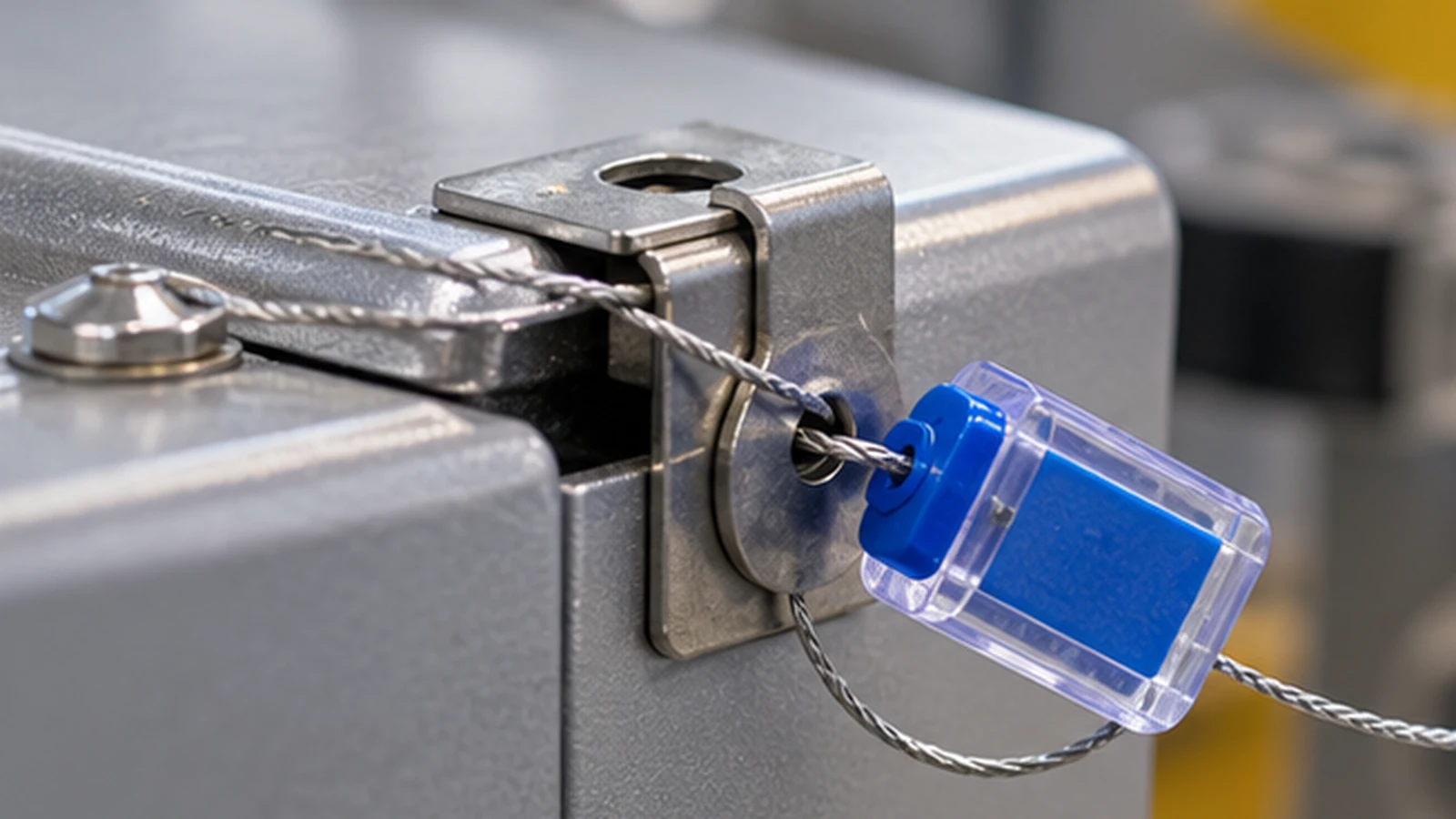
A gas meter measures the quantity of gas passing through it, but confidence in its readings depends on more than the accuracy of its measuring mechanism. Access to sensitive components, protection of accumulated readings and the ability to reconstruct changes all matter. Conventional meters often rely visibly on physical seals, whereas smart meters may also require electronic and software-based safeguards.
This is an educational article, not a report of confirmed tampering, a new procurement or certification of any particular Ekbatan Gas Control product. Inspection, opening, repair and replacement of gas meters must be performed by authorized personnel under the applicable utility and national rules.
What does a metrological seal actually protect?
Metrological sealing protects elements whose alteration could affect a legally relevant measurement. Depending on the design, those elements may include the measuring chamber, register mechanism, calibration settings or memory holding accumulated gas volume. A seal is therefore not simply a decorative label or proof of ownership; its location must match the instrument architecture.
Clause 9.1 of OIML R 137-1&2:2012 addresses mechanical and electronic protection of metrological properties and the prevention of unauthorized access to stored measured quantities. The detailed form of verification marks and seals remains subject to applicable national or regional legislation.
Physical seals and verification marks
A mechanical seal may be a wire-and-crimp assembly, destructible label or another arrangement that makes access to a protected point evident. The central engineering requirement is that opening the protected component leaves a detectable trace. Recording seal identifiers, positions and initial condition at handover improves traceability.
What evidence should be recorded?
A verification mark and a protective seal do not necessarily serve identical functions. An intact seal does not prove that the meter remains within its maximum permissible error; metrological performance must be established through appropriate tests and records.
Electronic sealing and access control
In electronic instruments, safeguards can include access levels, parameter locks, event counters, software-integrity checks and change logs. Here, electronic sealing does not necessarily involve a physical part. Its purpose is to prevent unauthorized modification or make such modification evident.
For instance, a legally relevant parameter may be adjustable only in an authorized service mode. Access restrictions and traceability must then be demonstrated in the specific design and against applicable requirements. It would be incorrect to assume that every smart or upgraded gas meter has the same controls.

Why an event counter is not the same as a tamper verdict
An event counter may record entries into service mode or changes to a protected parameter. A tamper alarm may instead be triggered by an enclosure sensor, magnetic disturbance or other abnormal condition. Neither is, on its own, definitive evidence of the cause: sensor faults, authorized maintenance and installation conditions also require consideration.
A well-designed process associates the event with a time, device identifier, alarm type, communication state and subsequent investigation outcome where feasible. Thresholds and responses should be testable and risk-based rather than automatically attributing every alert to the customer.
The role of the audit trail
An audit trail is a structured record of interventions and changes relevant to measurement. OIML D 31:2023 addresses traceability of changes to legally relevant software and parameters within its applicable framework. Such a record helps establish what changed, when it changed and how the action was authorized.
Local logging versus live alerts
Records should be protected against unauthorized deletion or rewriting and retained for the specified period. Logging an event is not identical to transmitting an immediate alert: a device can store an event locally and send it during the next remote-reading session. Temporary network loss should not automatically erase the local record.

Separate measurement functions from communications
A smart meter may separate the legally relevant measurement and volume register from its communications module and network-management software. Architectural separation can reduce the risk that a connectivity update affects the legally relevant result, but the separation must be documented and tested.
An AMR server displaying a reading does not acquire the right to rewrite the meter’s legal measurement. Procurement specifications should identify the authoritative record, how it reconciles with the local display, and how disagreements between local and transmitted values are investigated.
What makes remote firmware updates sensitive?
Firmware updates can correct defects, yet updates touching legally relevant functions raise metrological questions. OIML D 31:2023 describes traced-update controls such as origin authentication, integrity checks, logging and preservation of existing records. Whether a particular update path is permitted depends on evaluation and the governing rules.
A buyer should ask about software version identification, rollback after failure, preservation of readings, parameter-change authorization and post-update testing. It is unsafe to assume that any over-the-air update can be installed without further evaluation or verification.
Three practical investigation scenarios
Scenario one: a cover was opened during authorized repair and an alarm was logged. Matching the serial number, work order and inspector’s record can explain the event. Scenario two: radio connectivity was absent for several days while the local register continued to advance. That alone is not tampering; the queued data and synchronization path need inspection.
When is metrological testing needed?
Scenario three: the dashboard value differs from the local display. Before drawing conclusions, verify units, reading timestamps, meter identity, reference-condition conversion and transmission integrity. These examples illustrate a diagnostic method; they do not describe real incidents.
From alert to defensible conclusion
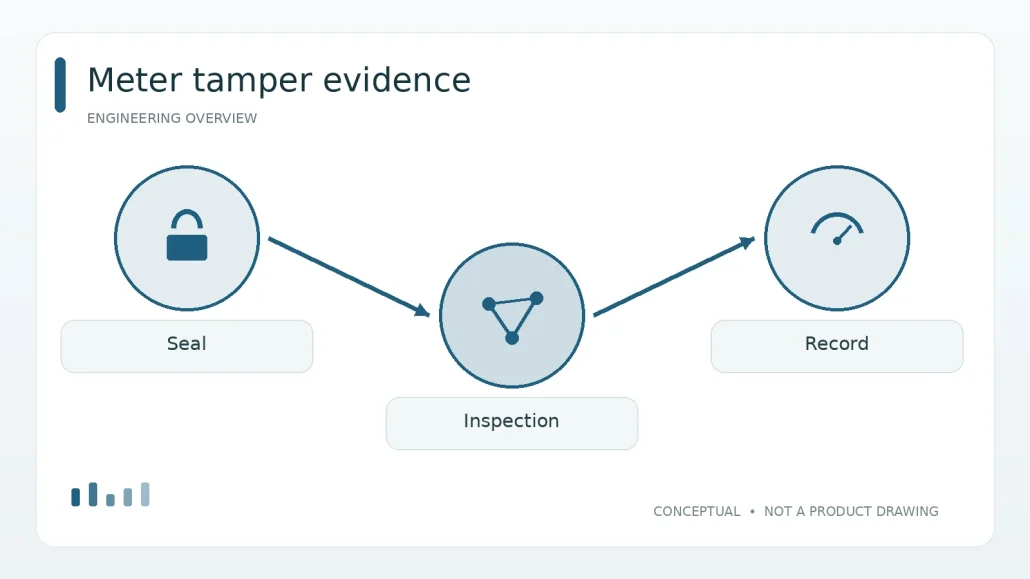
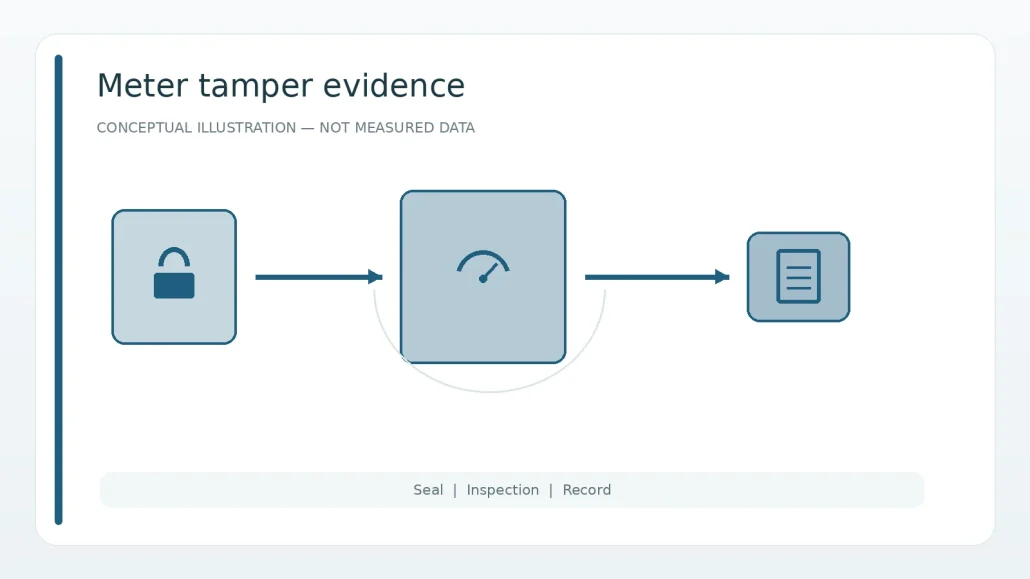
When a damaged seal or electronic alert is found, first preserve evidence: serial number, timestamp, photographs, displayed register value, seal condition and inspector identity. The meter and its records should then be examined under the official procedure by authorized staff. Unauthorized disassembly can compromise evidence.
Next review service history, audit trail, environmental conditions and, where warranted, metrological test results. The report should distinguish an alert, equipment fault, authorized intervention and substantiated tampering. A financial or legal decision cannot be inferred from one technical alarm alone.
What should a manufacturer document?
Institutional buyers should request drawings of seal locations, service-access procedures, firmware identifiers, event types, log-retention capacity, time synchronization, behavior during power and communication loss, and test evidence. Responsibilities among manufacturer, installer, utility and after-sales service provider should be explicit.
Limits of tamper-resistance claims
For residential gas meters, G4 meters, smart meters or retrofit modules, the evidence must apply to the exact model and revision. An unqualified “tamper-proof” claim without test scenarios, detection thresholds and false-alarm characterization is not an adequate technical specification.
International guidance versus national approval
OIML R 137 provides international gas-meter metrology recommendations. OIML D 31 is a general document on software-controlled measuring instruments, while WELMEC 7.2 provides European software guidance in its regulatory context. None of these publications, by itself, certifies a product or replaces Iranian legal and utility requirements.
For Iranian projects, the current rules of the National Iranian Gas Company, the Iranian National Standards Organization, tender specifications and model-specific type-approval and test records must be checked. Mentioning a standard in marketing literature is not equivalent to presenting valid certification for the product revision.
Conclusion for gas-meter manufacturers
Trustworthy gas metering combines measurement accuracy, physical protection, software security, traceable changes and an accountable investigation process. Smart gas meters create greater operational value when their data can be trusted and audited and when the limits of alarms are stated clearly.
For manufacturers including Ekbatan Gas Control, transparent documentation of sealing architecture, actual event-logging capabilities and test methods can improve technical assessment and after-sales investigations without attributing unverified features to any specific product.
Technical references
OIML R 137-1&2:2012 (including 2014 amendment): https://2013.oiml.org/publications/R/R137-1-2-e12.pdf
OIML D 31:2023 — General requirements for software-controlled measuring instruments: https://www.oiml.org/en/files/pdf_d/d031-e23.pdf
WELMEC Guide 7.2:2023 — Software Guide: https://www.welmec.org/welmec/documents/guides/7.2/2023/WELMEC_Guide_7.2_2023.pdf
OIML R 137 publication overview: https://www.oiml.org/en/publications/recommendations/137/