

Why one cubic metre does not always mean the same amount of gas
A gas meter typically records the volume passing through it at the conditions prevailing at the measurement point. When temperature or pressure changes, the volume occupied by the same quantity of gas changes. Two readings expressed in cubic metres are therefore not necessarily comparable unless their measurement basis is known. Engineering reports, mass balances and certain commercial measurement arrangements use conversion to defined reference conditions.
Gas volume conversion provides that common basis. For smart gas meters and automatic meter reading (AMR), transmitting a number without its temperature and pressure basis can create ambiguity. However, billing rules in Iran depend on applicable national regulations and approved practices. This discussion does not imply that every domestic meter needs a separate electronic volume converter.
Measured volume versus reference volume
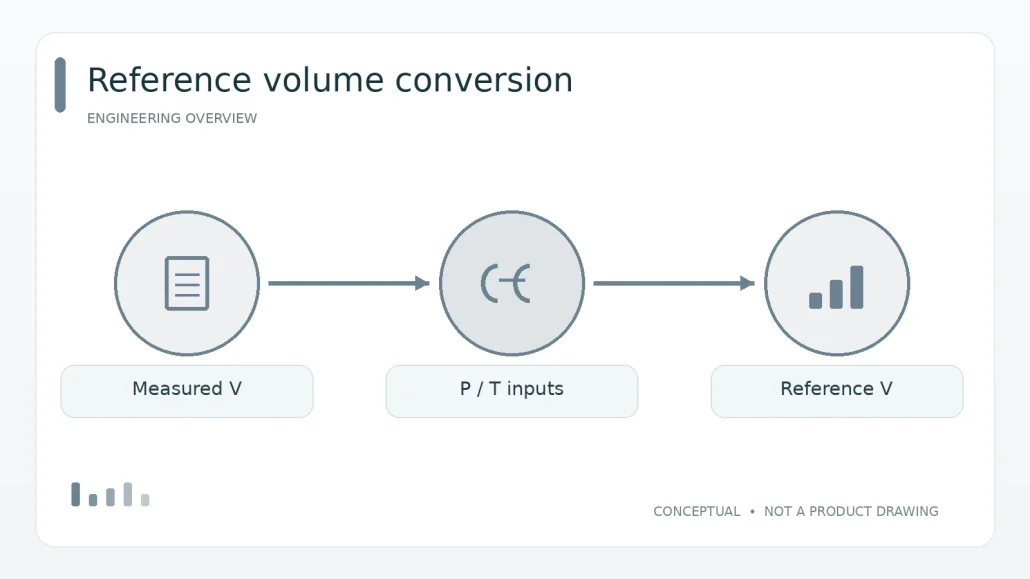
Measured or operating volume, Vm, refers to the conditions at the meter. Reference volume, Vb, is the volume the same quantity of gas would occupy at a specified reference pressure and temperature. Technical records should identify which value they contain; the expression “standard cubic metre” can be misleading when the actual reference conditions are omitted.

Natural gas reference conditions under ISO 13443
ISO 13443:1996, reconfirmed in 2025 according to ISO, defines reference conditions of 15 °C (288.15 K) and 101.325 kPa absolute for real dry natural gas. The conditions provide a consistent basis for volume and related gas properties.
They must not automatically be treated as the billing basis for every country or contract. National rules and commercial agreements may prescribe different reference temperatures or other conventions. Before processing a dataset, establish and document the governing reference conditions for that particular application.
The basic gas volume conversion equation
For a fixed quantity of gas, the general relationship can be written as Vb = Vm × (Pm / Pb) × (Tb / Tm) × (Zb / Zm). Here P is absolute pressure, T is temperature in kelvin, Z is the gas compressibility factor, and the subscripts m and b denote measurement and base conditions.
For a simplified ideal-gas teaching example, Zb/Zm is taken as one. For real gas—especially at higher pressures or in accuracy-sensitive custody transfer—ignoring the compressibility ratio without checking composition and operating range can introduce error. The selected method for calculating Z must match the applicable standard and contractual requirements.

Worked example using absolute pressure
Assume a meter indicates 100 m³ at 120 kPa absolute and 20 °C (293.15 K). Use reference conditions of 15 °C and 101.325 kPa, and assume Zb/Zm = 1. The resulting conversion factor is approximately 1.1641, giving a reference volume of about 116.41 m³.
This is a mathematical illustration, not a gas-billing method, a universal residential-meter correction factor or a tested performance figure for an Ekbatan product. The stated 120 kPa is an absolute pressure. Substituting gauge pressure directly into the equation is a common and potentially substantial mistake.
T, PT and PTZ conversion: what changes?
T conversion accounts for temperature while other assumptions follow the relevant design and rules. PT conversion uses measured pressure and temperature while assuming a constant compressibility factor. PTZ conversion also accounts for variation in the gas compressibility factor.
EN 12405-1:2021 addresses construction, performance, safety and type testing of electronic volume conversion devices associated with gas meters for these three approaches. Its scope does not cover every form of temperature compensation integrated into a meter that displays only converted volume; the product-specific standard must also be considered.
When is the more complex method justified?
A relatively stable low-pressure application may be adequately served by a simpler arrangement. An industrial station with varying pressure, large throughput or stringent commercial requirements may call for more comprehensive PTZ conversion. The choice should be based on uncertainty analysis, pressure and temperature range, gas composition, maintenance burden and legal metrology—not the technology label alone.
Common installation and data-processing errors
The first mistake is confusing gauge pressure with absolute pressure. The second is using degrees Celsius rather than kelvin in temperature ratios. The third is assuming Z remains constant across all operating conditions and gas compositions. A fourth is placing the temperature probe where it does not represent the actual gas temperature.
Double correction is another risk. If the meter or its associated module already outputs converted volume, applying the conversion factor again in a server can corrupt the result. Each record should state whether the volume is measured or converted, which sensors and factors were used, and which algorithm version produced it.
Implications for smart gas meters and AMR platforms
Digitalisation involves more than sending a reading. Reliable records need the meter identifier, timestamp, units, reference conditions, sensor status, alarms and traceable configuration history. A smart gas system should distinguish measured volume, converted volume and calculated energy; these are different quantities.
For upgraded gas meters or remote-reading deployments, the device output must be understood before it is connected to billing software. Adding a sensor or algorithm does not replace type approval, calibration, data-security controls or the gas utility’s applicable requirements.
Engineering checklist for specifying and testing a converter
Begin with the contractual reference conditions, absolute-pressure and temperature ranges, gas composition and required uncertainty. Then assess sensor placement, event logging, parameter sealing, tamper resistance and tests at the operating-range limits.
Acceptance tests should examine not only conversion error but also behaviour after power interruption, sensor failure, clock changes, communications loss and data recovery. Results must be documented for the specific device model. A generic standard alone does not establish a particular product’s performance.
Conclusion
Volume conversion makes gas measurements comparable at a declared reference state. Choosing among T, PT and PTZ requires an application-specific engineering and regulatory decision. For manufacturers of residential gas meters, smart gas meters and gas regulators, clear measurement definitions and trustworthy data are as important as the hardware. This educational guide makes no claims about approvals or performance of Ekbatan Gas Control products.
Frequently asked questions
Does one cubic metre always represent the same amount of gas?
No. Volume depends on temperature and pressure; readings can be compared properly only when their measurement or reference conditions are known.
Does ISO 13443 determine every Iranian gas bill?
No. It specifies international reference conditions; national billing and contract requirements must be checked separately.
Why does the formula require absolute pressure?
Absolute pressure is measured relative to vacuum; gauge pressure is relative to the atmosphere. The conversion equation uses absolute pressure.
What is the difference between PT and PTZ conversion?
PT uses pressure and temperature with a constant compressibility assumption. PTZ also accounts for changes in the compressibility factor.
Must every smart gas meter include PTZ conversion?
No. The need depends on the application, pressure range, contract and legal-metrology requirements.
Does an AMR reading automatically represent reference volume?
No. AMR is a data-transfer method. The meter specification must state whether the transmitted quantity is measured or converted volume.
Technical references
ISO 13443:1996 — Natural gas: standard reference conditions
EN 12405-1:2021 — Gas meters: volume conversion devices
OIML R 137-1&2:2012 — Gas meters