

Iran’s president has reported that a substantial portion of damaged natural-gas production capacity remains unavailable. According to Shana’s report published on 15 October 2026 at 15:06 Iran time, approximately 230 million cubic metres of production capacity was affected, about 100 million cubic metres has been restored, and roughly 130 million cubic metres remains offline. These figures describe capacity, not necessarily the measured daily volume of gas missing from customer deliveries.
The announcement matters ahead of the colder months, when residential heating demand can rise sharply. Interpreting it correctly requires distinguishing technical capacity, actual production and network demand. This article separates the official statement from engineering analysis and explains where reliable gas metering and demand management fit into the wider picture.
What did the official statement say?
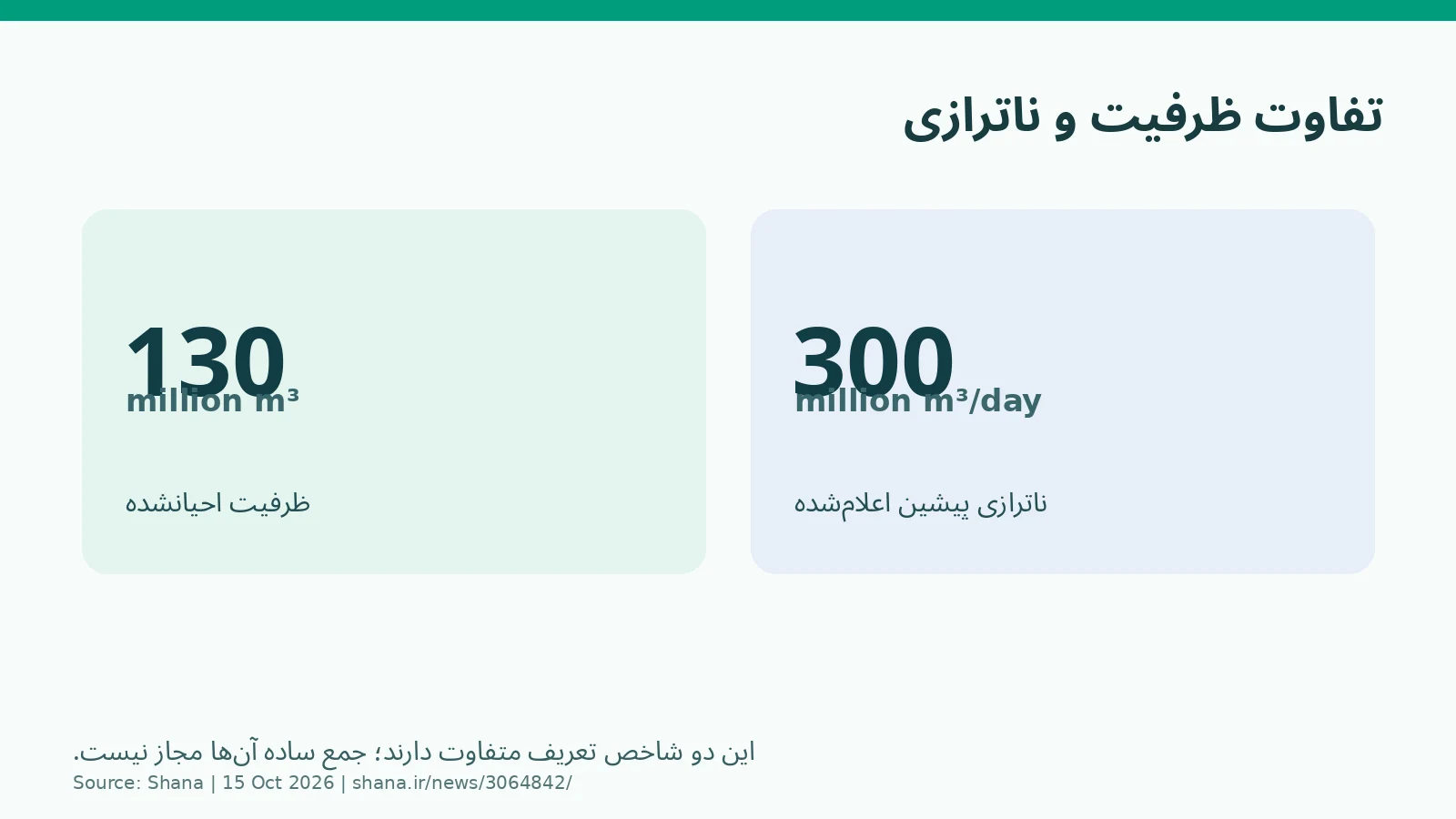
President Masoud Pezeshkian made the remarks on Thursday, 15 October, at a provincial planning and development meeting in East Azerbaijan. He also referred to an earlier gas supply–demand imbalance of approximately 300 million cubic metres per day, which he said existed before the recent damage. He emphasised efforts to restore production facilities and maintain energy supplies for industrial activity. The news report does not publish a plant-by-plant capacity breakdown or a detailed methodology for the estimates.
| Reported indicator | Figure | How to read it |
|---|---|---|
| Damaged production capacity | About 230 million m³ | Capacity affected; not a verified daily delivery loss |
| Capacity restored | About 100 million m³ | Portion of the affected capacity reportedly recovered |
| Capacity still unavailable | About 130 million m³ | Not yet restored at the time of the statement |
| Pre-existing imbalance | About 300 million m³/day | A separate estimate of supply–demand imbalance |
Why the 130 million and 300 million figures cannot simply be added
The 130 million figure refers to capacity that has not yet returned to service. The 300 million m³/day figure refers to a pre-existing supply–demand imbalance. Adding them into a definitive 430 million m³/day shortfall would require compatible definitions, the same reference period, evidence about actual production and demand, and an assessment of statistical overlap. Those details are not provided in the source, so such an addition would be misleading.
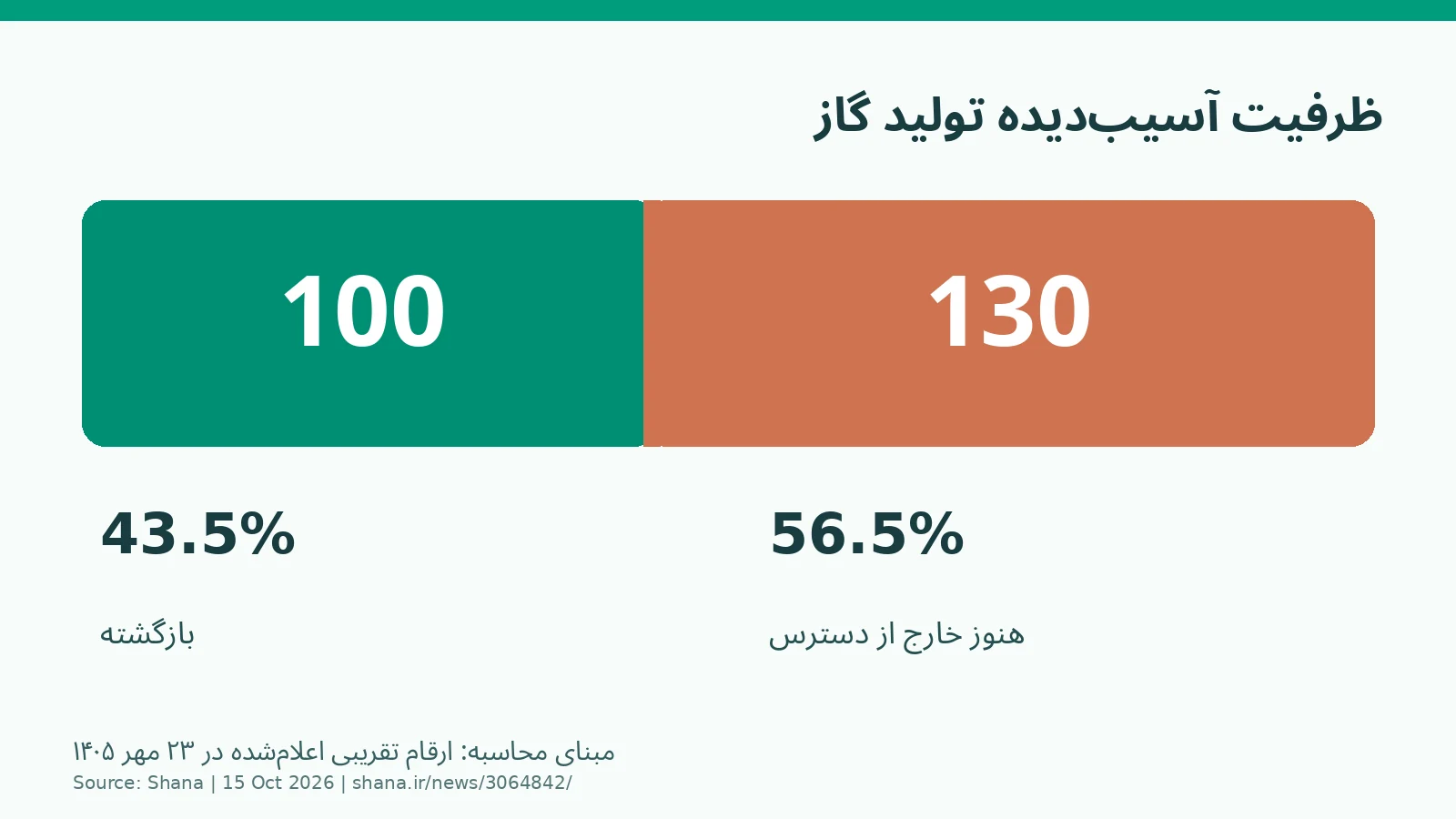
How much of the affected capacity has reportedly returned?
Using the rounded figures solely for illustration, 100 divided by 230 is approximately 43.5%; the remaining 130 divided by 230 is approximately 56.5%. These are editorial calculations of the share of reported damaged capacity. They are not an official rehabilitation-completion indicator and do not represent percentages of Iran’s total national gas production capacity.
A meaningful assessment of restored service would require evidence of mechanical completion, safety testing, stable commissioning, gas quality, pipeline throughput and actual operating data. A construction milestone does not automatically equal sustained delivery to the gas network. The same distinction applies when reading announcements about individual processing trains or refinery repairs.
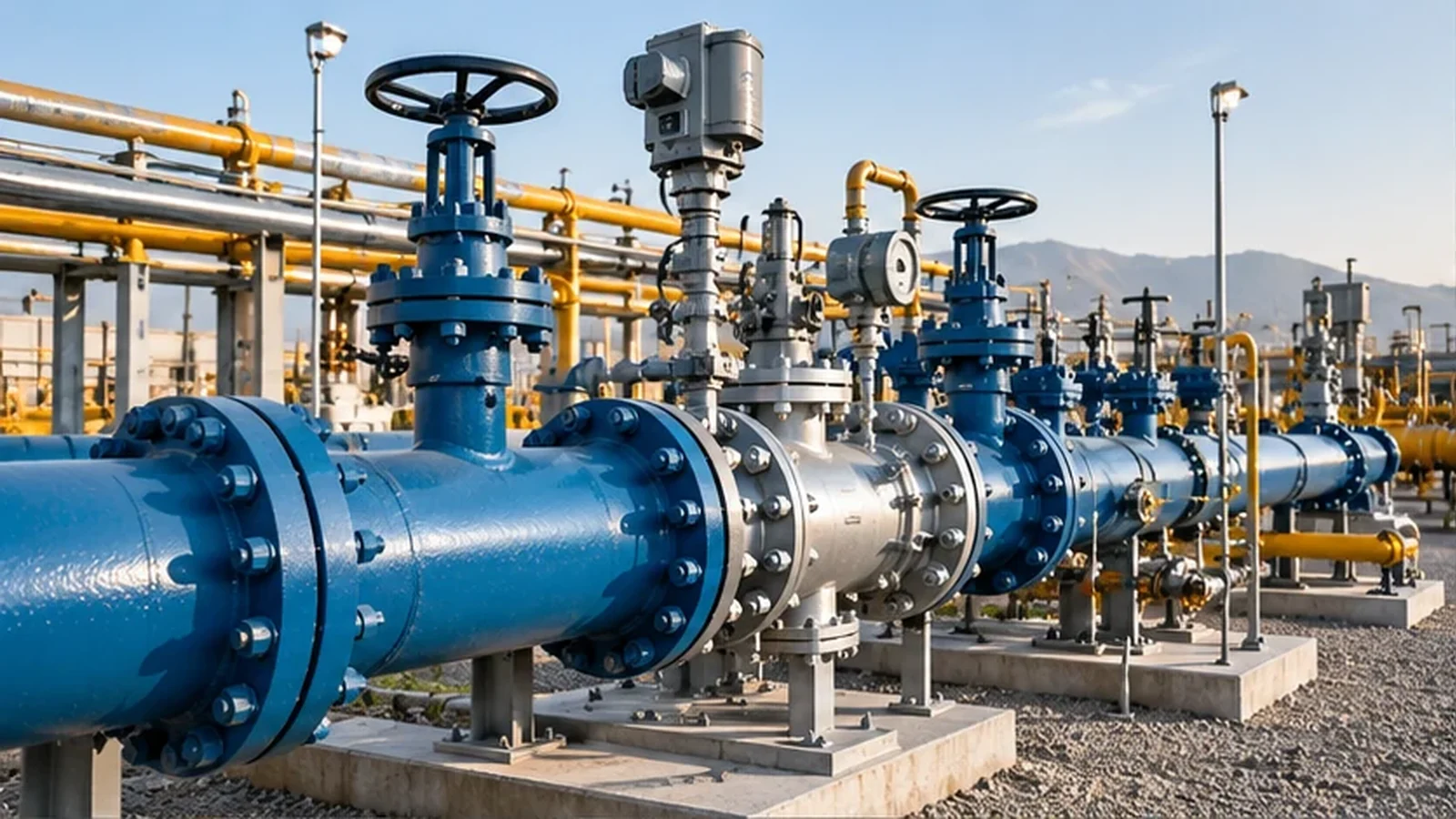
Potential implications for the 2026–27 heating season
Higher heating loads can place additional pressure on production, processing, transmission and distribution. Unavailable capacity may reduce operational flexibility, but the practical impact depends on temperature, daily demand, alternative available capacity and system conditions. Shana’s report does not provide a regional winter scenario or a forecast of interruptions. It would therefore be inappropriate to predict specific customer outages from these numbers alone.
Why industrial continuity is part of the discussion
In the same meeting, the president linked responsible household consumption with efforts to maintain energy supply for factories and protect employment. From an energy-management perspective, reducing avoidable losses and shifting non-essential peak loads can help balance a stressed system. The impact of any measure, however, must be established using an explicit baseline, credible measurements and appropriate weather adjustments.
Where smart gas meters and measurement systems contribute
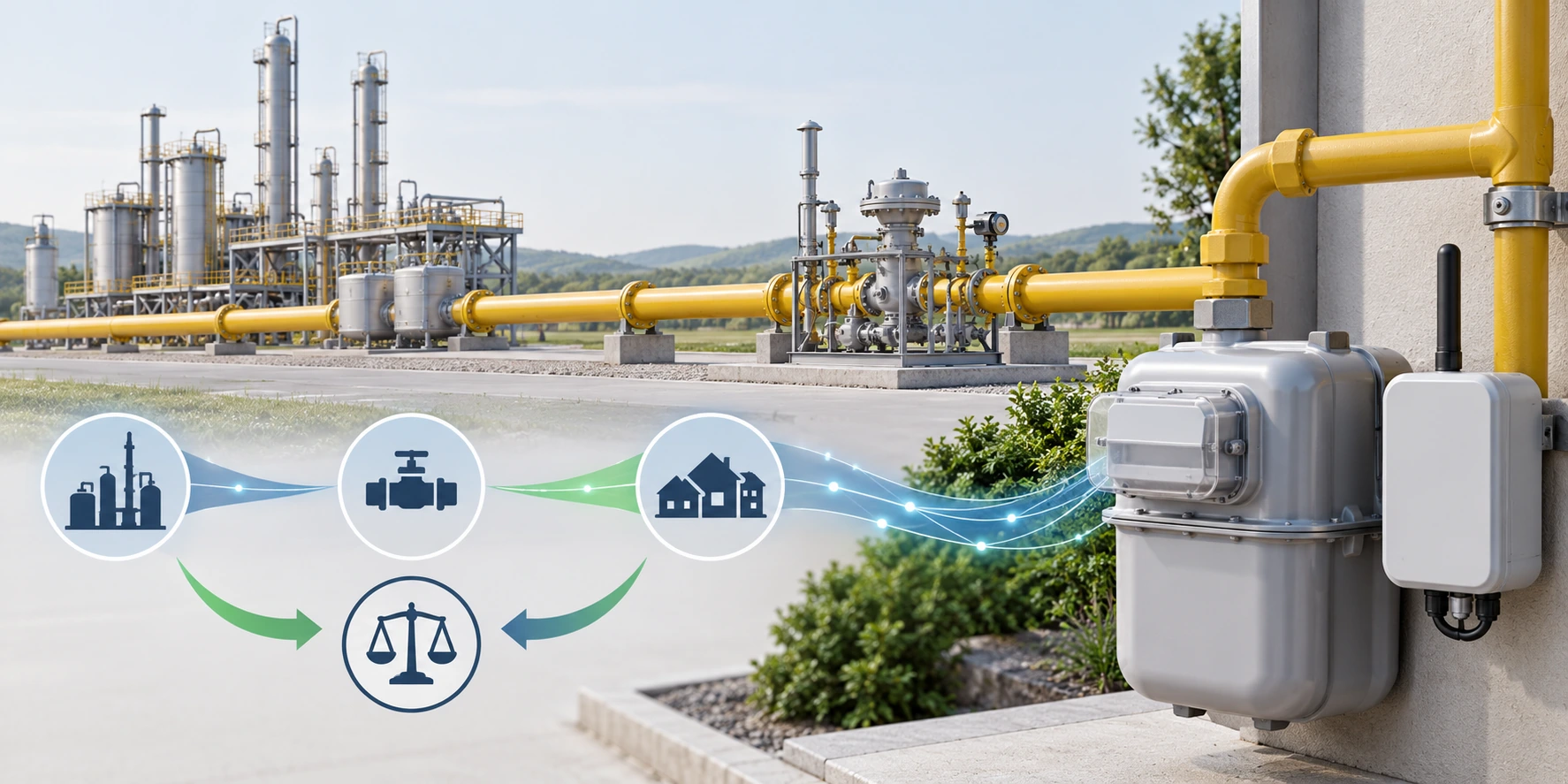
A gas meter measures gas volume at a defined point. A smart gas meter, where supported by approved hardware and communications, can provide interval readings and configured alerts to a management platform. It does not create new production capacity. Its value is in improving visibility of consumption patterns, supporting investigation of anomalies and helping evaluate energy-saving programmes.
Selecting a residential gas meter, including G2.5 and G4 classes, requires attention to flow range, operating conditions and applicable approvals. The class designation alone does not guarantee performance under every installation condition. A gas pressure regulator serves a different purpose—controlling pressure rather than measuring or correcting gas volume. Calibration, data integrity, access control and maintenance all matter to trustworthy analysis.
The relevance for gas equipment manufacturers
For manufacturers such as Ekbatan Gas Control, the broader lesson concerns measurement quality, traceable data and suitability for real network conditions. The official report does not attribute any role in the capacity-recovery projects to Ekbatan Gas Control, and this article makes no such claim. In advanced gas metering infrastructure, data quality begins at the physical measuring device, not only in the software platform.
What additional evidence is needed?
| Question | Evidence required | Why it matters |
|---|---|---|
| What is actually being produced? | Timestamped operating output | Separates installed capacity from real throughput |
| When is capacity truly restored? | Commissioning and stable-service records | Avoids confusing construction progress with operation |
| What is the customer impact? | Regional load and peak-demand data | Supports evidence-based assessment |
| How are savings verified? | Baseline, meter data and adjustments | Separates weather effects from efficiency gains |
Regular, comparable reporting on operational capacity, actual production, network loads and restoration milestones would allow industry readers to distinguish firm results from plans and estimates. Until such data is available, the safest editorial approach is to retain the exact scope and qualifications of the original official figures.
Conclusion
The 15 October 2026 announcement identifies approximately 130 million cubic metres of damaged gas production capacity as still unavailable, while about 100 million cubic metres has reportedly been restored. This is significant news for winter energy planning, but it does not establish a precise daily supply deficit, a nationwide outage forecast or a confirmed restoration date. Infrastructure recovery and evidence-based consumption management should be assessed as complementary, distinct activities.
Sources and editorial method
Primary source: Shana, 15 October 2026, 15:06 Iran time, reporting the president’s remarks. Related context: Shana’s separate report on the South Pars Phase 14 processing train. The percentages in this article are editorial arithmetic using rounded source figures; gas-metering discussion is general technical analysis, not a claim about a particular contract or certified product.