
What changed in Iran’s reported oil production capacity?
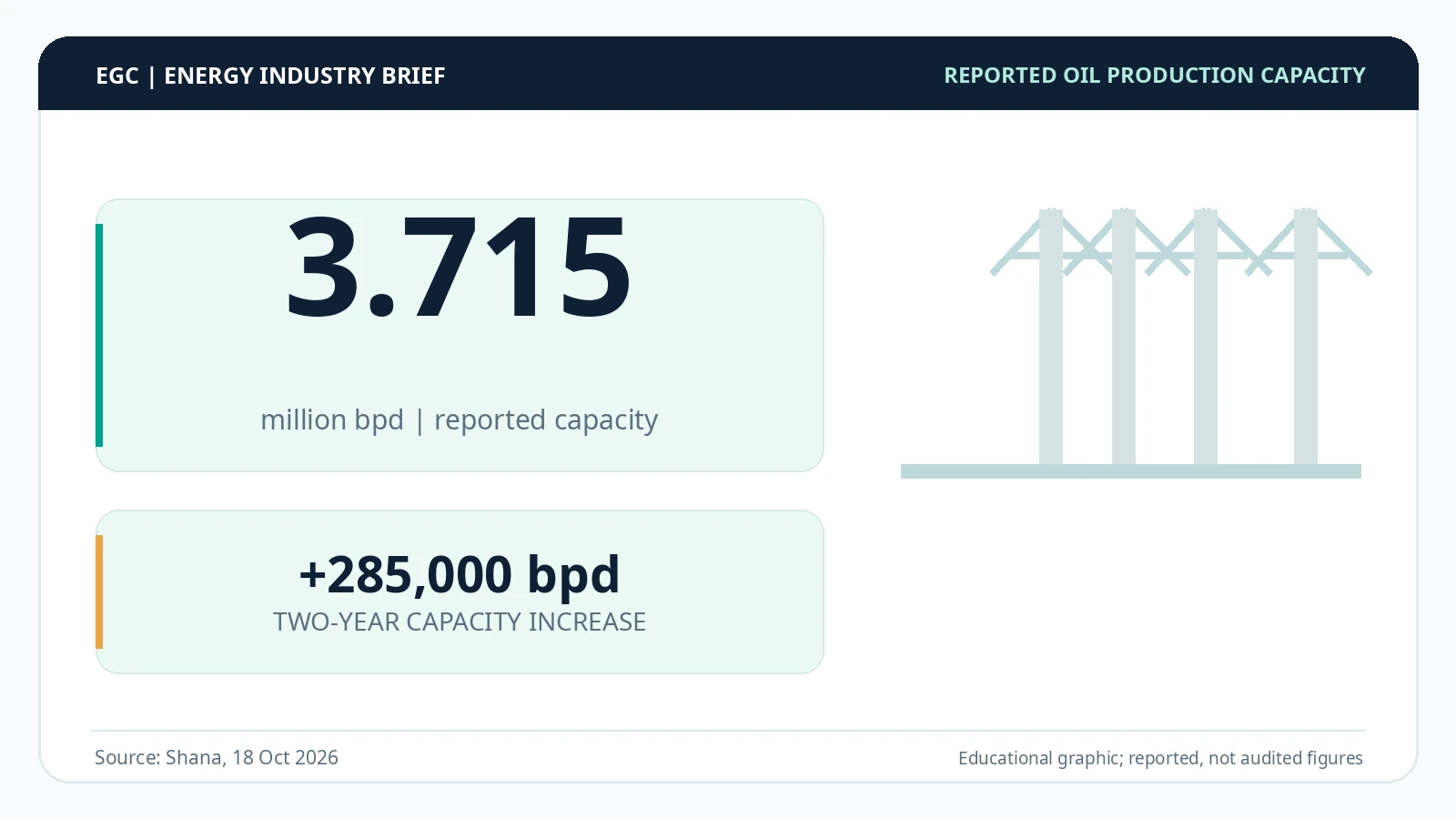
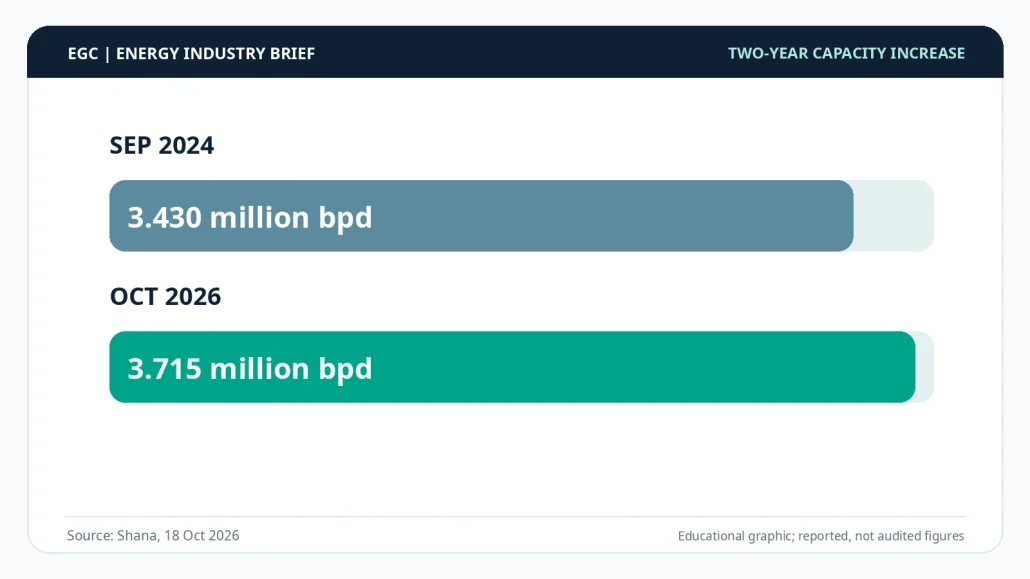
On 18 October 2026 (26 Mehr 1405), Shana published figures attributed to IRNA showing that Iran’s reported daily crude-oil production capacity rose from 3.430 million barrels per day in September 2024 to 3.715 million barrels per day in October 2026. The difference is 285,000 bpd, equivalent to approximately 8.3% of the earlier capacity. These are reported figures, not findings from an independently published operational audit.
The significance goes beyond a headline number. Capacity expansion produces durable economic value only when wells, processing plants, transport infrastructure, financing and monitoring systems can operate together. For energy-sector readers, it is essential to distinguish production capability from barrels actually produced and barrels sold.
Capacity, available capacity and actual production are not interchangeable
Capacity describes the potential output of an installation under defined conditions. Actual production is the measured volume recovered over a specified period. Maintenance outages, reservoir performance, processing constraints and transport bottlenecks can separate the two. The same report also mentions a 55,000-bpd increase in oil production in October 2026 compared with October 2025. That one-year output change must not be added to the two-year capacity increase.
Key figures and how to interpret them
| Indicator | Reported value | Appropriate interpretation |
|---|---|---|
| Capacity in September 2024 | 3.430 million bpd | Baseline capacity |
| Capacity in October 2026 | 3.715 million bpd | New reported capacity |
| Two-year capacity change | 285,000 bpd | About 8.3% growth |
| Production change vs October 2025 | 55,000 bpd | Output change, not capacity |
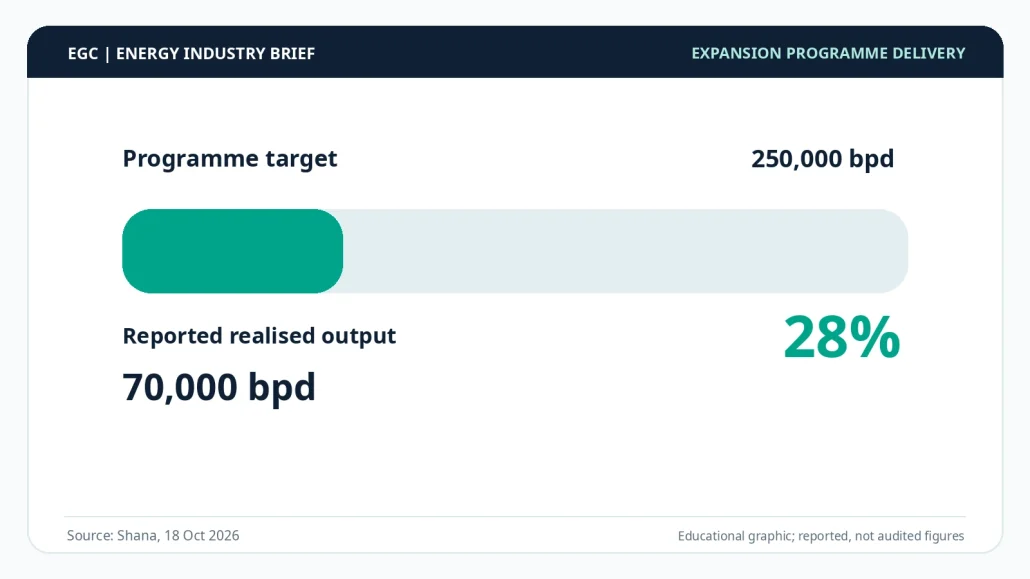
| Targeted expansion programme | 250,000-bpd target; 70,000 bpd realised | About 28% of programme target |
The figures represent different periods and metrics. In particular, the programme’s 70,000 bpd should not automatically be added to the 285,000-bpd capacity increase. The report does not provide a breakdown demonstrating that they are separate, additive gains.
Where does the 250,000-bpd expansion programme stand?
According to Shana, a targeted crude-oil expansion programme was defined with an intended increase of 250,000 bpd and a stated budget of US$3 billion. The report says 70,000 bpd of that target has been realised. Dividing 70,000 by 250,000 gives approximately 28%. This is progress against the reported production-output target; it is not a physical-construction progress percentage or a budget-disbursement ratio.
Financing structure and execution risks
The report describes an 80% financing contribution from Iran’s National Development Fund and 20% from the National Iranian Oil Company. These percentages describe the stated financing arrangement, not verified amounts already disbursed. Equipment lead times, well completion, commissioning and specialist services all affect how quickly a financing plan can become stable output.
Field-development agreements and processing capacity
The source reports that development contracts covering Azadegan, Azar, Changuleh and Band-e Karkheh fields have been formally endorsed, with aggregate investment of approximately €13 billion. Endorsement is a contractual milestone; it does not establish that every project is complete or producing.
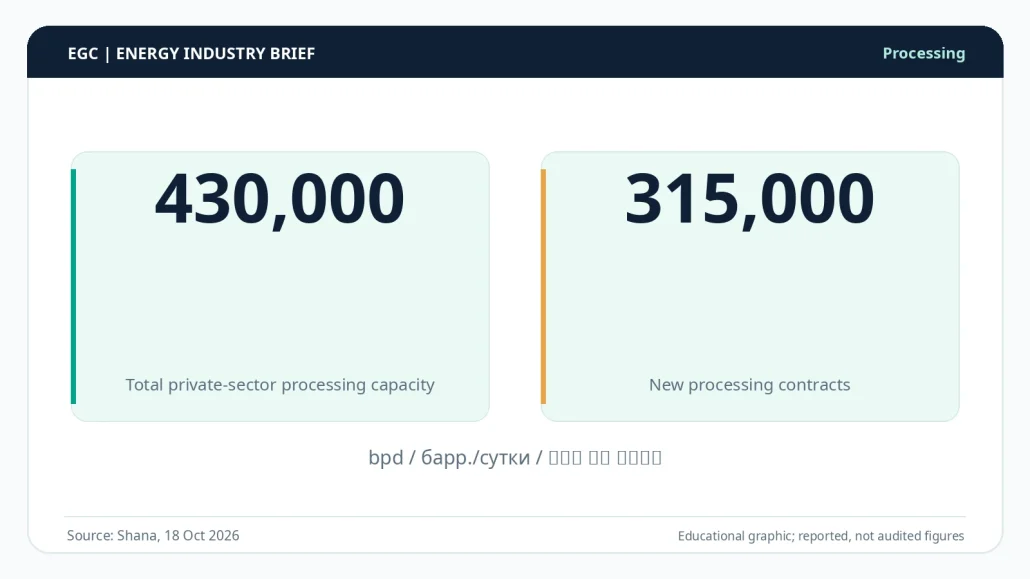
For processing infrastructure, the report refers to private-sector contracts for 315,000 bpd of new processing capacity, bringing the total processing capacity assigned to the private sector to 430,000 bpd. The 315,000-bpd component and the 430,000-bpd total should not be added together as independent quantities.
Why processing matters as much as drilling
A productive well cannot necessarily deliver its intended rate without adequate separation, stabilisation, storage and transportation. Well deliverability, plant throughput, pipeline constraints and export-quality requirements must therefore be assessed as a connected system. A processing contract represents a potential enabling investment, not proof of current throughput.
Drilling activity and well services
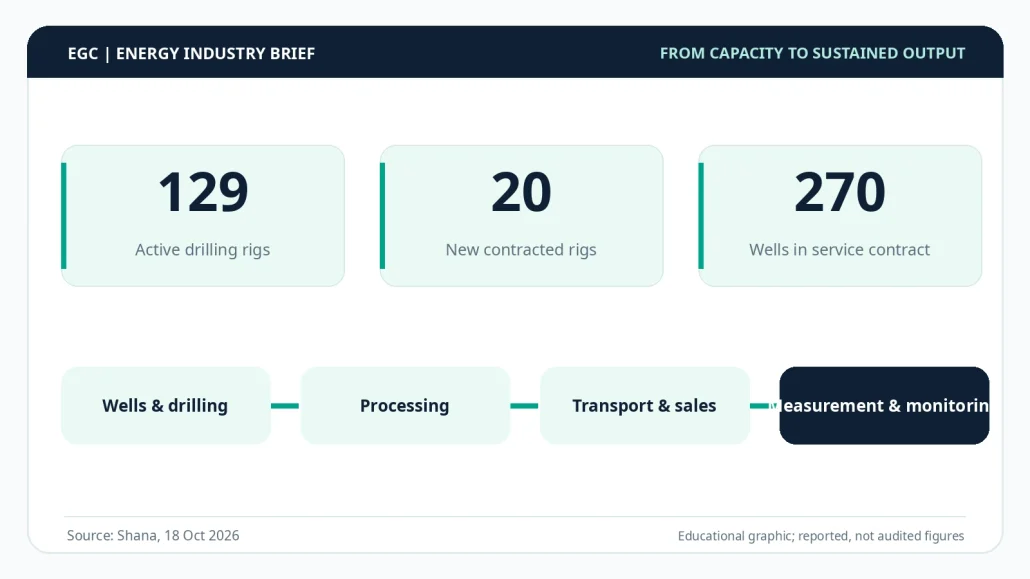
The report states that 129 drilling rigs were active nationwide and that a services contract worth around US$1 billion had been signed for 20 additional rigs and drilling 270 wells. An active rig, a contracted rig and a completed well are different indicators. Well counts alone cannot forecast production without information about initial rates, decline curves and commissioning dates.
Why reliable measurement is essential to sustained output
Oil operations require consistent records of flow, pressure, temperature, downtime and fluid quality. An effective operational dashboard must reconcile well data with processing and transportation data using common units, timestamps and measurement boundaries. Without that discipline, apparent performance gains can be misleading.
Associated gas, flaring and energy efficiency
Oil production often generates associated gas that may be collected, processed, reinjected or used as fuel. Reliable gas-flow measurement, pressure control and leak monitoring support material-balance calculations and loss assessments. However, the 18 October report provides no new quantified associated-gas capture or flaring-reduction result. Such savings must not be attributed to the reported oil projects without evidence.
Relevance to gas equipment manufacturers
For manufacturers of gas-control and metering equipment, the story illustrates the value of traceable measurements across the energy chain. Nevertheless, residential gas meters, smart customer meters and upstream industrial metering skids operate under different pressures, flow ranges, fluid compositions and standards. Suitability for a particular duty must be supported by the relevant product specifications and certifications.
What should the next progress report disclose?
A meaningful follow-up would publish at least five indicators over consistent reporting periods: available operating capacity, actual average daily production, processing-plant utilisation, wells newly brought online and associated-gas volumes captured. It should also clarify whether reported numbers are daily peaks or period averages, and how maintenance and transportation constraints were treated.
Together, these measures would reveal whether the reported capacity expansion is translating into sustained production and lower energy losses. Until more operational data are released, the appropriate approach is to preserve clear distinctions between targets, contracts, capacity and actual output.
Conclusion
The reported 285,000-bpd rise in Iranian crude-oil capacity between September 2024 and October 2026, alongside new field, processing and drilling-service agreements, points to an active capacity-building programme. Yet capacity, contracts, targets and measured production are four distinct concepts. Evaluating their economic and energy effects requires transparent, verifiable operational data.
Source and methodology
Primary source: Shana, “Iran’s Oil Production Capacity Increases by 285,000 bpd,” 18 October 2026, 13:35 Iran time, citing IRNA. Percentage calculations in this article are editorial calculations based solely on the reported figures. No unsupported claim is made about the performance or deployment of Ekbatan Gas Control products.