
As the cold season approaches, gas demand management involves more than advice to lower home temperatures. A poorly adjusted central heating plant can burn fuel while a building is empty. Greenhouse temperature and humidity affect production quality, while industrial gas restrictions can disrupt manufacturing. Effective management therefore combines technical measures, data and behaviour.
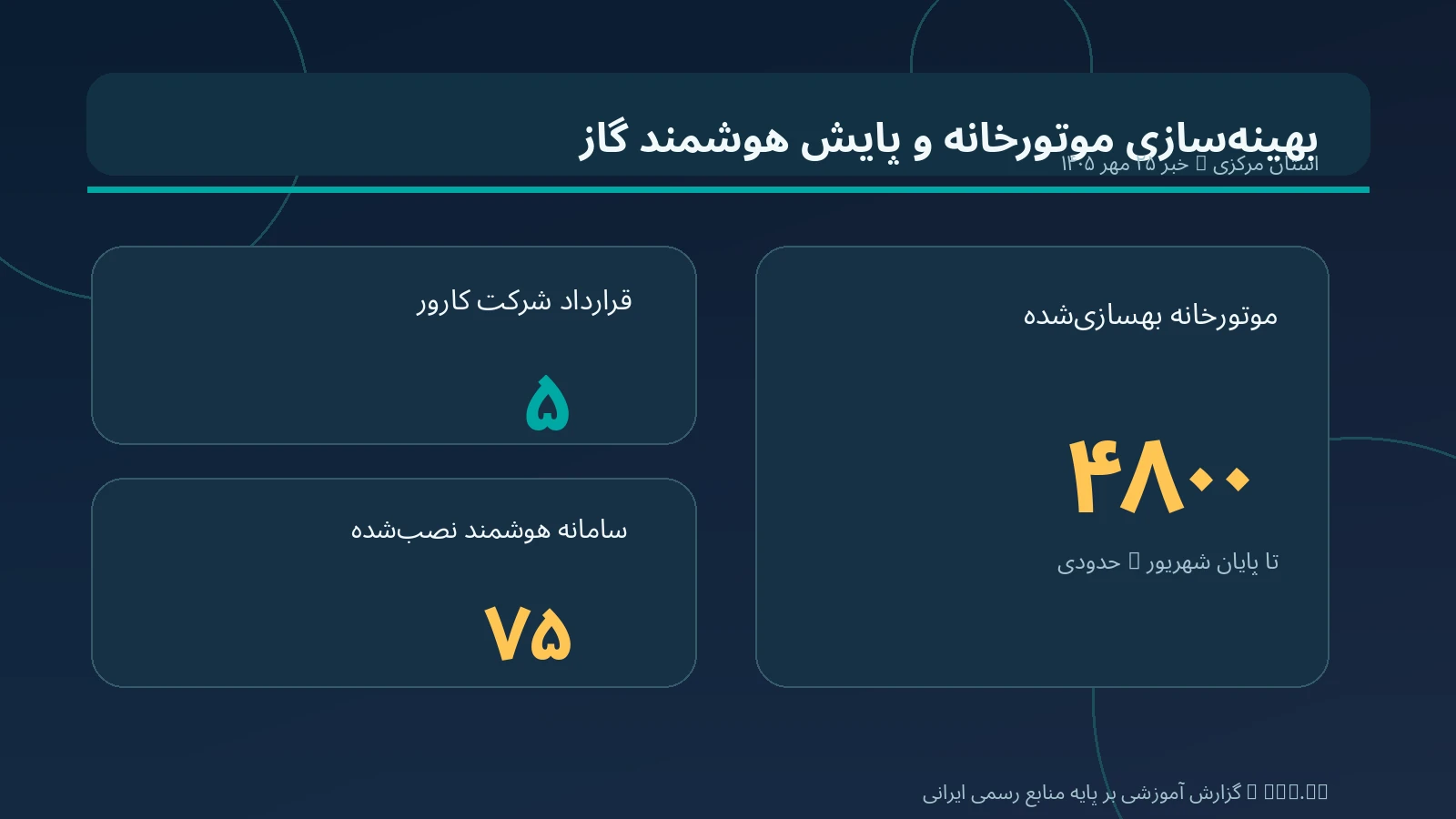
On 25 Mehr 1405, Markazi Province Gas Company’s managing director reported contracts with five energy service operators, around 4,800 boiler rooms refurbished by the end of Shahrivar, approximately 75 smart systems installed and smart kits fitted to the meters of about 500 high-consumption customers during the previous year. These are four different indicators. They must neither be added together nor collectively described as verified savings. Official source: Shana, 25 Mehr 1405.
The case raises practical questions: what does boiler-room optimisation involve, what does an energy service operator do, and how can meter data distinguish genuine savings from weather and operating-hour changes?
The latest reported figures in Markazi
Around 4,800 boiler rooms refurbished
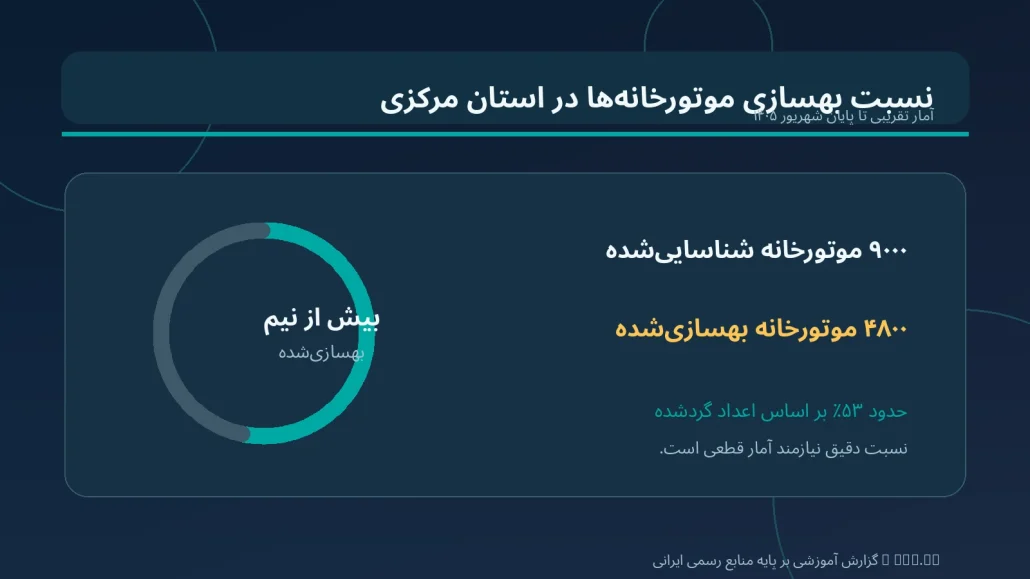
Managing director Mohammadreza Samiei said approximately 4,800 boiler rooms had been refurbished by the end of Shahrivar 1405. Nearly 9,000 had been identified, with more than half covered. Because the inputs are approximate, a percentage with many decimal places would imply false precision. The simple ratio 4,800/9,000 is roughly 53%, consistent with “more than 50%”.
Five operators, including two focused on households
The company reported contracts with five energy service operators, two focusing on household efficiency and promoting appropriate consumption. A signed contract establishes a cooperation framework; it does not establish that every planned project has been completed. Assessing each operator requires separate data on delivered projects and verified savings.
Why 75 systems and 500 meter kits are different
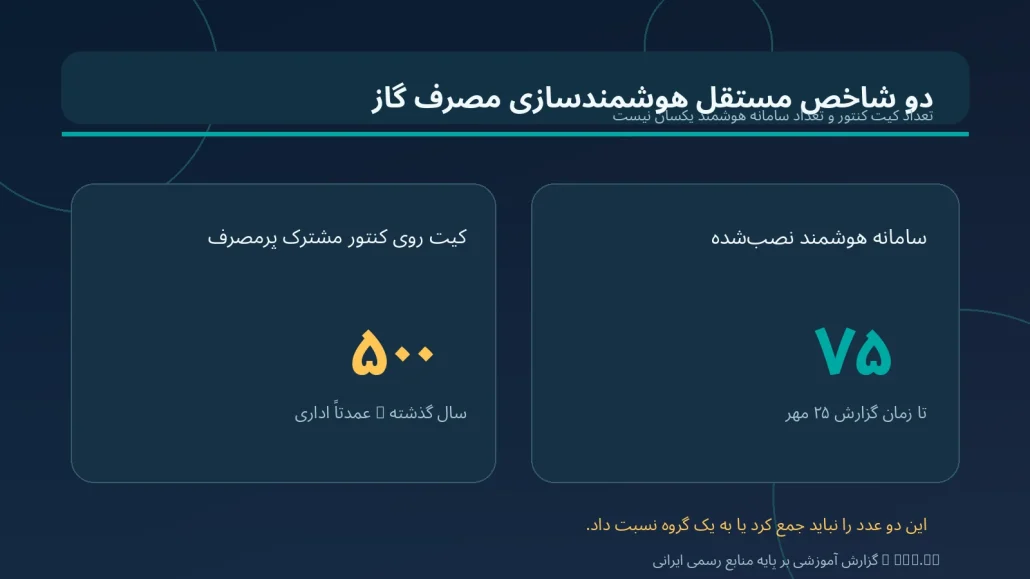
The 25 Mehr report describes around 75 smart systems installed to date and plans for more. Separately, it says kits had been fitted to approximately 500 high-consumption customers’ gas meters, mainly offices, in the previous year. Their periods, equipment types and programme boundaries differ. They must not be added into one total of 575 devices or interpreted as 500 smart boiler rooms. Source: Markazi Gas Company report in Shana.
What does boiler-room optimisation mean?
Repair and efficiency improvement are different
Repair normally corrects a particular failure, such as a defective component or leak. Optimisation is broader: delivering the building’s required heat with less waste under actual conditions. A boiler can work without an obvious fault while its water temperature, schedule or burner settings remain unsuitable. Being functional alone does not prove efficiency.
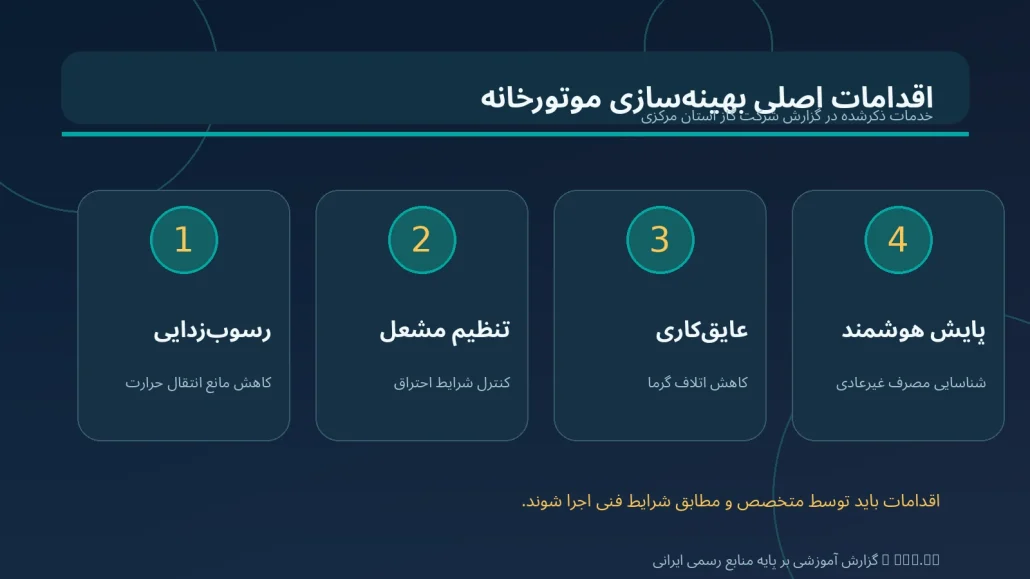
Descaling, insulation and burner adjustment
The official report lists descaling, equipment repairs, insulation and burner adjustment among the free programme’s services. Scale can impede heat transfer, while poor insulation wastes heat through pipes and equipment. Burner adjustment needs suitable instruments and a qualified specialist to preserve combustion quality and safety. No individual measure guarantees the same percentage reduction in every building.
Operating schedules in offices
Keeping an empty school or office at occupied-hours heating levels may waste energy. Lower settings must still respect comfort, frost protection and operational requirements. Schedules, target temperatures and performance monitoring may help, but should follow an assessment of the building and heating system.
What does an energy service operator do?
From identifying opportunities to implementing improvements
An operator may assess consumption, identify avoidable losses and cooperate in implementation and monitoring under a contract. Responsibilities, financing, equipment ownership and settlement methods vary. The Markazi news does not establish the legal or revenue arrangements of the five contracts; those require their actual documents.
Why greenhouses and industrial facilities matter
The managing director emphasised cooperation with production units and greenhouses. Greenhouse heating affects crop growth, so indiscriminate temperature cuts may damage production. Industry also needs to distinguish useful process energy from avoidable waste. An operator adds value when improvements preserve acceptable quality, safety and production capacity.
Contracts are not verified savings
Operator counts describe programme organisation, not cubic metres saved. Evaluation needs a baseline, assessment period, weather and production changes and valid data. The 25 Mehr report gives no separate gas-savings volume or financial value for these Markazi projects. Extrapolating a provincial or national savings figure from boiler-room counts would therefore be unsupported.
How smart boiler-room systems work
Sensors, controllers and commands
A suitable control system may record air or water temperature, equipment operation and other defined parameters. Within programmed and safety constraints, its controller can issue permitted commands. Exact functions depend on the device and heating plant: the word “smart” does not establish one universal set of capabilities.
Heating schedules and consumption monitoring
Operating-hour and temperature records can reveal activity outside a school’s or office’s schedule. The provincial report mentions identifying heating left running outside office hours. An alert, however, is different from automatic heating shutdown. Any automated action must be supported by specifications and operating instructions.
Data need follow-up action
A chart does not itself reduce gas use. If nobody investigates an unusual-consumption alert, its potential benefit is lost. Assign responsibility, record the action taken and compare subsequent consumption with a valid baseline. This cycle of data, decisions and evaluation determines the value of smart control.
What can a smart meter kit tell us?
Smart meters and upgraded meters
A smart gas meter may be designed with recording and transmission from the outset. An upgraded meter may be an existing device fitted with compatible, approved equipment. Actual capabilities depend on the meter, kit, approval and communications infrastructure. The phrase “smart kit” in the report does not identify a protocol or sampling interval.
Identifying out-of-hours consumption
With sufficient time resolution, readings can compare closed or out-of-hours periods with occupied hours. Unexpected consumption can prompt inspection of the boiler room, water heaters or other loads. Night consumption alone does not prove waste: security staff, night work or particular heating requirements may explain it.
What about G4 and G2.5 meters?
G4 and G2.5 identify recognised meter capacity classes for suitable applications, rather than smart functionality. Meter and upgrade-kit selection must respect flow, pressure, safety and technical approvals. The provincial report does not identify the fitted meter models, so it cannot establish that the kits were installed on G4 or G2.5 devices.
Consumption management in schools and offices
Why unoccupied hours matter
Schools need sufficient heat during attendance. After closing, lower targets may be appropriate if compatible with frost protection, equipment and special building requirements. The objective is to avoid heat with no operational benefit while preserving necessary heating.
There is no single reported temperature for every building
The Markazi report calls for a standard temperature range but gives no universal setting for every school and office. Appropriate conditions depend on use, climate, applicable rules and occupants. A specific temperature should not be invented and attributed to the 25 Mehr announcement. Settings require valid criteria and the facilities manager’s assessment.
What should facilities staff monitor?
Track gas consumption, plant hours, outdoor conditions, repairs and alerts. If weekly consumption rises, investigate colder weather, greater occupancy or incorrect equipment settings first. One bill or a short chart can be misleading.
Measuring genuine savings
Define the baseline before improvements
Document normal consumption and its period and conditions using meter readings, bills, temperature records and operating schedules. A main meter may serve heating, kitchens and water heaters together; a lower total bill cannot automatically be attributed only to the boiler room.
Adjust for weather and changes in use
Winters differ in cold days, schools may change hours and factories may raise output. Before-and-after use should be compared under equivalent conditions as far as possible. Consumption per floor area or operating hour can help, but does not replace a specialist building assessment.
A hypothetical calculation
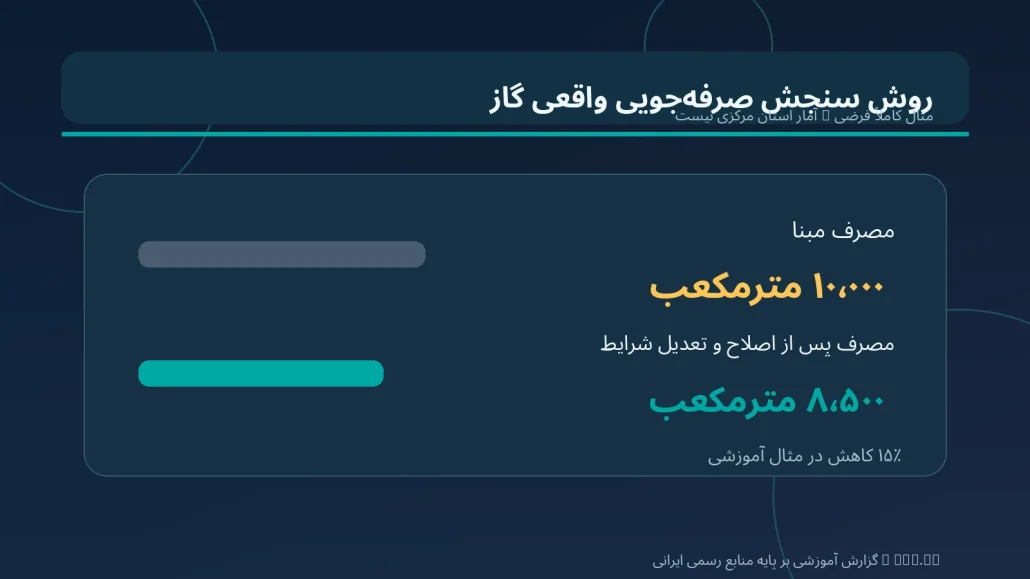
Suppose a building uses 8,500 rather than 10,000 m³ in equivalent periods after weather adjustment. The hypothetical reduction is 1,500 m³, or 15%. These figures explain calculation only and have no connection to reported Markazi performance. Formal reporting needs a defined measurement and verification method for the project.
What does the free programme include?
Reported services
The managing director named free descaling, repairs, insulation and burner adjustment, and mentioned smart installations in refurbished plants. Free provision in the report does not establish unconditional eligibility for every building. Service scope and acceptance conditions must be confirmed with the provincial gas company.
Which buildings need assessment first?
Older plants, unusual consumption, poor insulation and irregular schedules may justify technical assessment. The programme authority determines priorities under its approved criteria. A boiler room or high consumption alone does not establish an entitlement to all services.
Information to prepare for an enquiry
Customer number, address, building use, approximate plant details and consumption history may help. Obtain the official application route, required documents and inspection timing from Markazi Gas Company or the local office. The cited report provides no dedicated registration number or public application URL; a speculative link should not be supplied.
Gas imbalance and industrial production
Reducing unnecessary winter demand can ease network load while preserving comfort and safety. The count of 4,800 refurbished plants cannot determine how many million cubic metres are released on a peak day; that needs measured volumes and the timing of savings.
In Shana’s 20 Mehr 1405 report, National Iranian Gas Company’s managing director called for provincial operator service desks and data-based tools, including an AI-assisted predicted-consumption bill. This provides policy context, but does not establish that all Markazi customers already receive such bills.
Releasing gas for productive sectors is a stated policy objective. Actual industrial allocations depend on network conditions, timing, contracts and operational decisions. One building project cannot establish that the identical gas volume reaches a particular factory on the same day.
Regulators, measurement and efficiency
Meters measure gas use; regulators control pressure within their design range. Both matter but perform different tasks. Arbitrarily adjusting a regulator to reduce a bill is neither a valid optimisation method nor a safe action. Pressure checks and gas equipment work require qualified personnel.
A smart gas system can gather measurements and equipment status within its verified capabilities. Accurate, timestamped, comparable data help reveal changing patterns and evaluate improvements. Transmission alone still needs analysis and action.
Domestic measurement, control and communications manufacturers may find opportunities as monitoring grows, provided standards, compatibility and security are met. This is an analysis of technical needs, not a contract claim. Shana does not name Ekbatan Gas Control as the Markazi project’s supplier or operator, so no such involvement is asserted.
Challenges at provincial scale
Consumption data need clear access, retention and privacy rules. Failed sensors or communications can leave gaps; data quality and calibration status must be checked before analysis.
After installation, controllers need review when seasons or building uses change. Staff training, planned inspections and fault records matter as much as procurement, especially where facilities personnel change frequently.
Public reporting should distinguish refurbished buildings, active systems, baseline use, adjusted post-project use and persistence of savings. The Markazi report primarily describes implemented activities rather than audited reductions. That distinction marks the boundary between implementation reporting and a confirmed result.
From refurbishment to measurable energy management
The 25 Mehr announcement provides four separate indicators: five operator contracts, around 4,800 refurbished boiler rooms, about 75 smart systems and meter kits for roughly 500 high users in the previous year. Each has value, but none alone states a gas-savings quantity.
Lasting reductions require technical improvement, valid measurement and follow-up. For offices, schools, greenhouses and factories, successful optimisation means a measurable change in energy use as well as new equipment.
Official sources
- Shana, 25 Mehr 1405: energy service operators in Markazi gas efficiency.
- Shana, 20 Mehr 1405: provincial service desks and predicted-consumption billing.
- Shana, 20 Mehr 1405: saved gas and productive-sector use.
Frequently asked questions
How many boiler rooms had been refurbished by the end of Shahrivar 1405?
Approximately 4,800, according to Shana’s 25 Mehr report. The figure is approximate.
How many were identified in Markazi?
Nearly 9,000, with more than half reported as refurbished.
How many energy service operators are contracted?
Five, including two focused on households and efficient-consumption awareness.
Is the programme free?
The reported services are described as free. Eligibility and scope must be confirmed with the provincial company.
What services are included?
Reported services include descaling, repairs, insulation and burner adjustment; smart systems in refurbished plants are also mentioned.
How many smart systems were installed?
Around 75 in the 25 Mehr report. This differs from the meter-kit indicator.
Were 500 new smart meters installed in Mehr 1405?
No. The report says kits were fitted to meters of about 500 high users during the previous year.
Has an official savings volume been published?
The 25 Mehr report gives no separate cubic-metre savings figure for these provincial projects.
How can smart meters support lower consumption?
Recording and transmission support pattern detection and evaluation. A meter alone does not reduce consumption.
Are G4 and G2.5 inherently smart?
No. These are meter classes. Smart functions depend on design, recording or transmission and approvals.
How can a building apply?
Ask the provincial company or local gas office for the official route and requirements. The report provides no dedicated public registration link.
Is Ekbatan involved in the Markazi project?
The cited official sources do not name it as contractor or supplier, so specific participation cannot be confirmed.