
In cold weather, network gas pressure is more than a number on a station screen. It reflects transmission and feeder pipelines, customer withdrawals, station capacity and operational decisions. Delayed information makes a fluctuation harder to diagnose and manage. Online pressure monitoring is therefore an important part of distribution and supply network management, although it cannot alone replace infrastructure development or demand reduction.
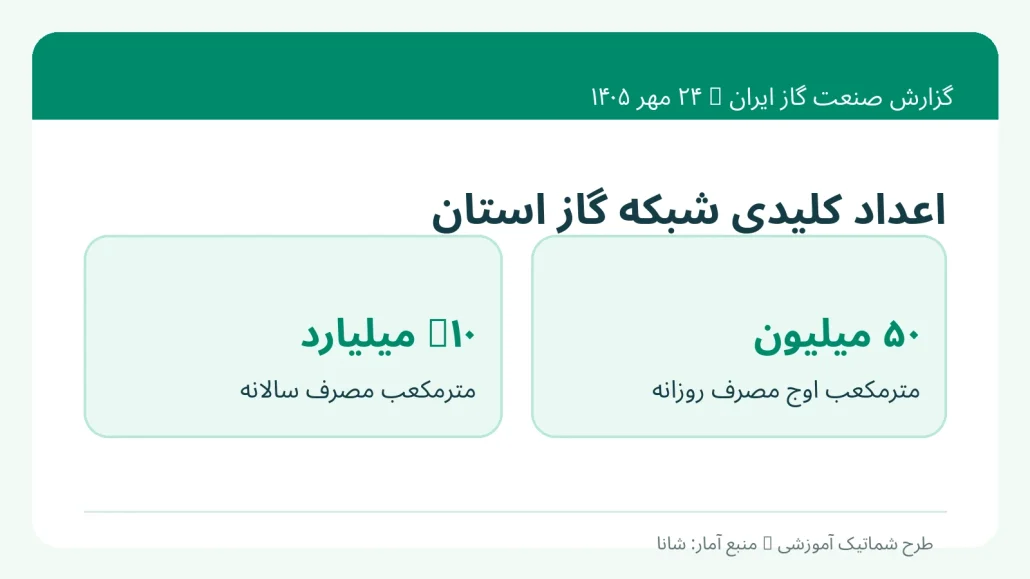
Shana’s 24 Mehr 1405 report on East Azerbaijan’s winter preparations brought this issue into focus. The provincial gas company’s managing director said all gas stations had online monitoring and pressure fluctuations were continuously observed. The same report described annual consumption exceeding 10 billion m³, peak daily demand around 50 million m³ and several network-strengthening projects.This article explains online monitoring, how it differs from smart metering, what data help assess pressure changes and why valid consumption measurement complements transmission and pressure-control infrastructure.
What East Azerbaijan announced on 24 Mehr 1405
What has reportedly been implemented?
The managing director said all provincial gas stations had online monitoring. This is a statement about station equipment, not smart meters for every household or automation of every network decision. The report does not give an exact station count, supplier names or equipment specifications; these should not be guessed.
Which infrastructure projects remain on the agenda?
The company also identified the 10-inch Hashtrood transmission pipeline, Horand–Abesh Ahmad feeder, completion of the Marand feeder and station-capacity development. These were described as strengthening areas including Hashtrood, Ajab Shir, Maragheh, Marand, Horand, Kaleybar and Khoda Afarin. Planned or ongoing work differs from full commissioning; dates and final operating capacities need project-specific confirmation. Source: Shana.
What do the main consumption figures mean?
More than 10 billion m³ describes annual consumption; approximately 50 million m³ describes a peak day. They cannot be directly compared without aligning periods. The report also puts the province’s share above 7% of national consumption. That proportion should be interpreted within the report’s own calculation period and scope.
What is online gas pressure monitoring?
Online monitoring versus periodic readings
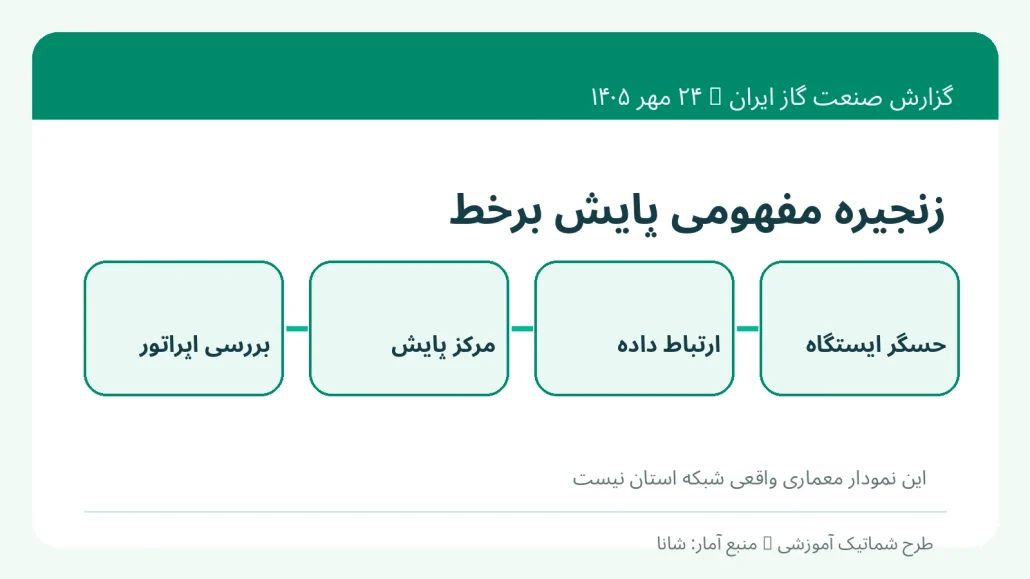
Online systems transfer measurements from selected points at specified intervals. Operators can examine pressure trends, abrupt changes and communications status. Periodic readings are collected less frequently, often for consumption records or scheduled checks. “Online” does not mean zero delay or observation of every network point. Sampling intervals and coverage depend on the architecture.
Which data might be recorded?
Depending on station design, inputs may include inlet and outlet pressure, temperature, flow, selected valve states, alarms and communications quality. The phrase online monitoring alone proves none of these individual functions. Assess actual capabilities through instrumentation drawings, signal lists and system specifications.
Why trends matter more than one value
A pressure value without time, location and withdrawal conditions gives limited information. A trend over several hours may distinguish gradual from sudden changes. Comparing it with demand, pipelines and maintenance helps prioritise possible causes. A definite conclusion still requires sufficient data and technical investigation.
Why pressure changes in winter
Simultaneous household demand
Cold weather brings many heaters into service together. Higher withdrawals can change flow and pressure. Whether disruption follows depends on transmission capacity, topology, station settings and equipment. A local pressure drop does not by itself prove reduced national production.
Feeders and station capacity
Pipelines transport gas between parts of the chain; stations manage pressure for network levels. More sensors cannot remove a capacity bottleneck. Monitoring may reveal it earlier, while pipeline or station expansion is a separate engineering response where justified.
Demand management complements expansion
New lines and stations require time and investment. Avoiding unnecessary peak consumption can ease demand, but does not replace adequate capacity. Stability needs infrastructure, maintenance, trustworthy data and consumer cooperation together.
Station monitoring and smart metering are different
What does a station system observe?
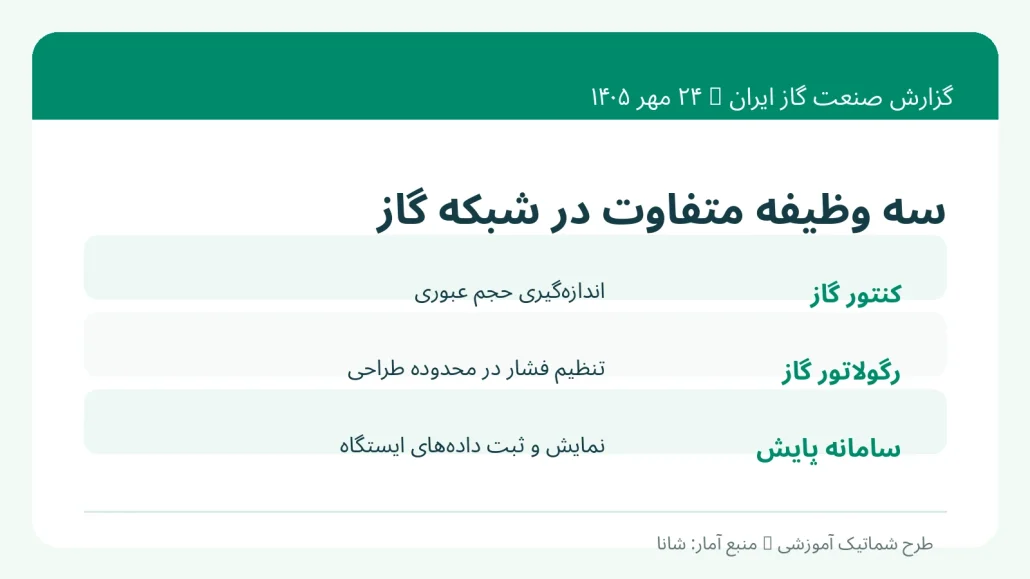
It records a particular network point’s pressure or operational state where the relevant sensors exist. The information supports operation and technical assessment. It does not necessarily know each household’s consumption.
What does a smart meter provide?
A gas meter measures volume within its specified technical range. Some smart models can record digitally or transmit consumption depending on the device and communications. Smart functionality alone does not establish a pressure sensor, leak detection or automatic shut-off. Those features must be explicit in the model specifications.
G4 and G2.5 do not define communications
These are technical meter classes, not proof of connectivity or pressure measurement. A conventional G4 meter is not smart merely because of its class. Selection requires suitable flow range, installation and standard and operator requirements.
An upgraded meter is not a station monitoring system
“Upgraded” may indicate functions added to a base model, but the technical record defines them. A station monitoring system combines sensors, communications and supervision software. Combining these sources can be useful, but customer volume and station pressure remain different data.
The regulator’s role
Regulators control outlet pressure within design limits; meters measure volume; monitoring observes and records conditions. These functions complement each other. Online observation cannot automatically repair a defective or unsuitable regulator.
A regulator cannot create missing inlet pressure or network energy. Insufficient inlet conditions or supply capacity require the operator and qualified specialists. Customer tampering with meters, regulators or connections is dangerous and is not a remedy for low pressure.
Interpreting the reported 475 million m³ saving
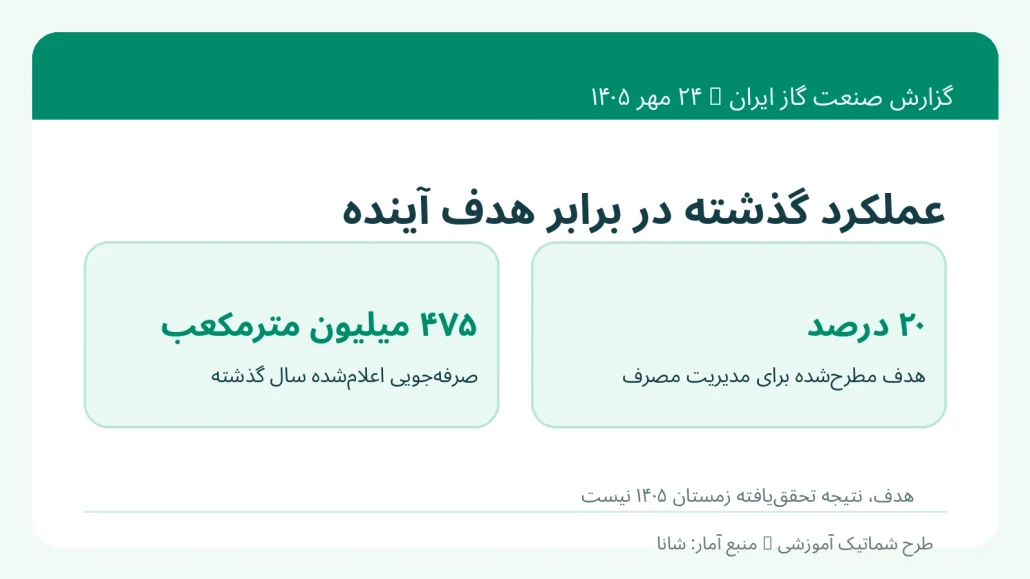
The figure concerns the previous year
In the 24 Mehr report, the managing director attributed 475 million m³ of savings and a 10% consumption reduction in the previous year to public participation in the “two degrees lower” campaign. These are the company’s reported historical figures. The news does not detail baseline calculation, weather adjustment or independent verification. It cannot determine each measure’s or household’s exact contribution. Official source.
A 20% target is not an achieved result
The same article describes a 20% reduction in the new campaign and comfort-temperature recommendations. This is a target or expected potential, rather than an achieved winter 1405 outcome. Final results need implementation and measurement over the relevant period.
An educational calculation
Suppose an adjusted baseline for a hypothetical building group is 12,000 m³ and actual consumption is 10,800 m³. The difference is 1,200 m³, or 10% of baseline. This illustration is not East Azerbaijan’s performance or a real project. Meter accuracy, occupancy and building-use changes also need consideration.
How smart gas systems can support efficiency
Finding unusual patterns
Regular, good-quality data allow daily or weekly comparisons with similar periods. Higher consumption while a building is closed may prompt a heating-settings review, but does not by itself establish a leak or fault. Site observations and technical assessment must complement data.
Calibration and data quality
Fast transmission of wrong readings does not improve decisions. Sensor accuracy, timestamps, communications error records, calibration and maintenance are essential. Large systems also need defined data responsibility and change records for traceability.
Security and communications continuity
Gas is critical infrastructure. Operational and information-system communications should follow appropriate security requirements. A communications outage must not be mistaken for a real pressure failure. Backup paths and safe operation need design review; the provincial report gives no security-architecture details.
Managing household and public-building demand
Comfort temperatures and unused rooms
The provincial report recommends 18–21°C and the “one warm room in every home” campaign. These recommendations must accommodate health and occupant needs, including children and older people. The objective is to avoid unnecessary heating of unused spaces while preserving essential warmth.
Boiler rooms and efficient heaters
The report mentions refurbishment, replacement of inefficient heaters and improvements to school heating. Their effects depend on individual buildings and need separate measurement. Being named in a programme does not mean completion in every building.
A lower bill is not sufficient evidence
Bill amounts depend on tariffs and reading periods as well as use. Technical evaluation compares volumes under similar conditions and considers weather, occupancy and use. A municipal gas meter measures; analysis and corrective decisions follow.
Industry, petrochemicals and power stations
Household demand management can increase operational flexibility in cold peaks. Establishing that a particular saving supplied a factory or power station requires allocation and delivery data. A reported reduction is not identical to gas delivered to industry.
Some petrochemical plants depend on gas for feedstock or fuel, and interruptions affect production. In an older Shana report of 6 Mehr 1405, the National Petrochemical Company’s managing director emphasised freeing energy from nonproductive uses. This is background, not new 24 Mehr news.
In IRNA’s 23 Mehr 1405 report, Tavanir’s managing director described plans for 938,000 smart fuses by year-end and procurement and installation of 12 million smart electricity meters. These are plans and targets, not final installation totals. Electricity and gas share a need for data and demand management, while their equipment, standards and operating conditions differ.
What this means for gas equipment manufacturers
Meter and regulator accuracy, traceability and maintenance matter as much as digital interfaces. Equipment unsuited to its application cannot provide dependable information merely through advanced communications.
Ekbatan Gas Control can explain the distinctions between smart and upgraded meters, G4/G2.5 classes and regulators. The cited 24 Mehr report does not identify the company as supplier or implementer of East Azerbaijan’s monitoring system, and no such participation is claimed.
Indicators for evaluating online monitoring
Technical indicators may include data availability, measurement quality, valid alerts, event-detection time and resolution time. These are suggested assessment measures; the report provides no results for them.
Demand programmes need adjusted consumption, peak demand, participating customers and corrective costs. A warmer day’s lower use should not be attributed to a project without adjustment. Safety incidents, response time and service quality also matter: savings must preserve safety and essential heating.
Monitoring is necessary, but not sufficient
The 24 Mehr report describes online station monitoring alongside feeders and demand programmes for winter. It reports over 10 billion m³ annually and around 50 million m³ on a peak day, as well as infrastructure projects.
Observing pressure, regulating it, measuring consumption and achieving savings are different functions. A resilient approach combines infrastructure, valid instrumentation, analysis, safe maintenance and demand improvements, with results assessed through measurable indicators.
Official sources
- Shana, 24 Mehr 1405: East Azerbaijan prepares its gas network for winter.
- IRNA, 23 Mehr 1405: electricity network controls and smart meter plans.
- Shana, 6 Mehr 1405: energy efficiency and petrochemicals, background source.
Frequently asked questions
Are all East Azerbaijan gas stations online?
According to the managing director in Shana’s 24 Mehr report, all are equipped with online monitoring. Exact station counts and equipment lists were not provided.
Does online monitoring prevent outages?
It supports diagnosis and operational decisions but creates no new supply or transmission capacity and cannot guarantee uninterrupted service.
Does a smart meter measure pressure?
The word smart does not prove that. Pressure measurement requires the relevant sensor and model specifications.
Is G4 the same as smart?
No. G4 is a technical meter class; smart functionality concerns specific digital and communications features.
Can a regulator fix insufficient network pressure?
It regulates within its design limits but cannot independently compensate for inadequate inlet pressure or network capacity. Unauthorised adjustment is dangerous.
When did the reported 475 million m³ saving occur?
It was reported as the previous year’s performance, not winter 1405 savings. The article does not detail independent verification.
Has the 20% reduction target been achieved?
The report presents it as a target or expected potential, not an achieved current-winter result.
Does station monitoring conclusively identify leaks?
No. Detection depends on sensors, coverage and methods. A pressure drop is not necessarily a leak.
How should building gas savings be assessed?
Compare actual use with a baseline adjusted for temperature, occupancy and use. Two bill amounts alone are insufficient.
Is Ekbatan the provincial monitoring contractor?
The cited official report does not name it as supplier or implementer.