
As the cold season approaches, boiler-room optimisation and gas consumption monitoring become increasingly important for offices, schools, commercial buildings and residential complexes. A heating plant whose schedule does not match occupancy, or which maintains a fixed water temperature regardless of outdoor conditions, may use more energy than necessary. Reliable measurement is needed to identify waste and establish the results of improvements.
This practical guide considers how managers should record consumption, which tasks belong to qualified heating specialists, how meter data help and how to avoid unsupported savings percentages. Technical explanations are general guidance and do not replace manufacturer instructions, safety rules or a qualified inspector’s assessment.
Why boiler-room optimisation matters in Iran
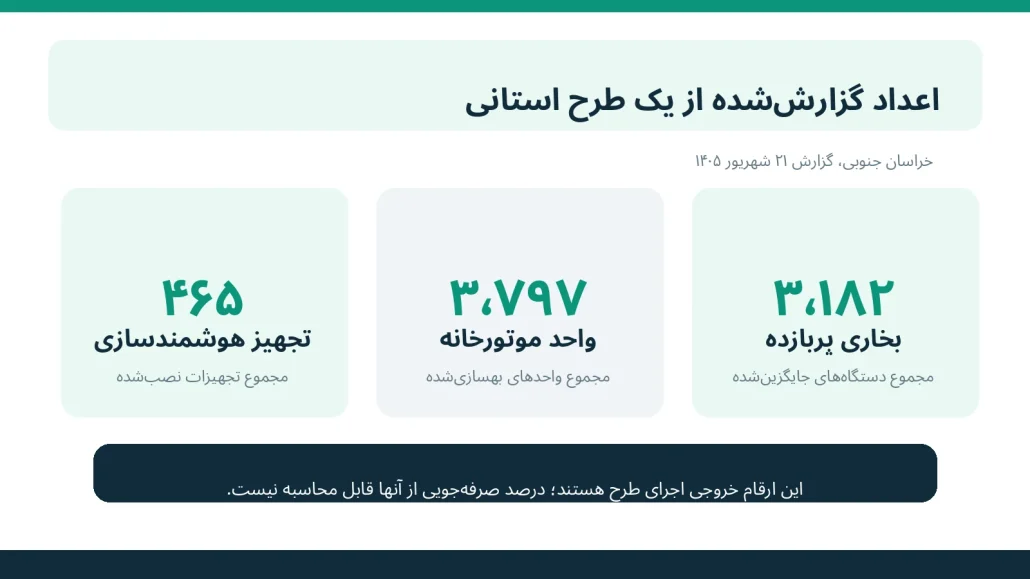
Central heating improvements are one route to gas demand management. In a Tasnim report dated 21 Shahrivar 1405, South Khorasan Gas Company’s managing director reported cumulative installation of 465 smart boiler-room devices and refurbishment of 3,797 boiler rooms. These numbers describe programme coverage, not a verified quantity of gas saved per building.
An Isfahan report dated 25 Khordad 1405 described expanding boiler-room optimisation and consumption-reduction targets for educational and administrative buildings. It also mentioned comparisons with the same period a year earlier, which become meaningful only when demand factors are considered.
This is an educational guide prepared for winter 1405, rather than breaking news from 22 Mehr. Provincial statistics must not be presented as the performance or results of Ekbatan Gas Control products.
What does a smart boiler room do?
In its simplest form, smart control adjusts some heating equipment automatically to actual building needs. A controller may use outdoor temperature, heating supply and return temperatures, operating hours and holiday schedules to avoid unnecessary operation. Scope depends on the system design, burner, pumps, control valves and controller capabilities.
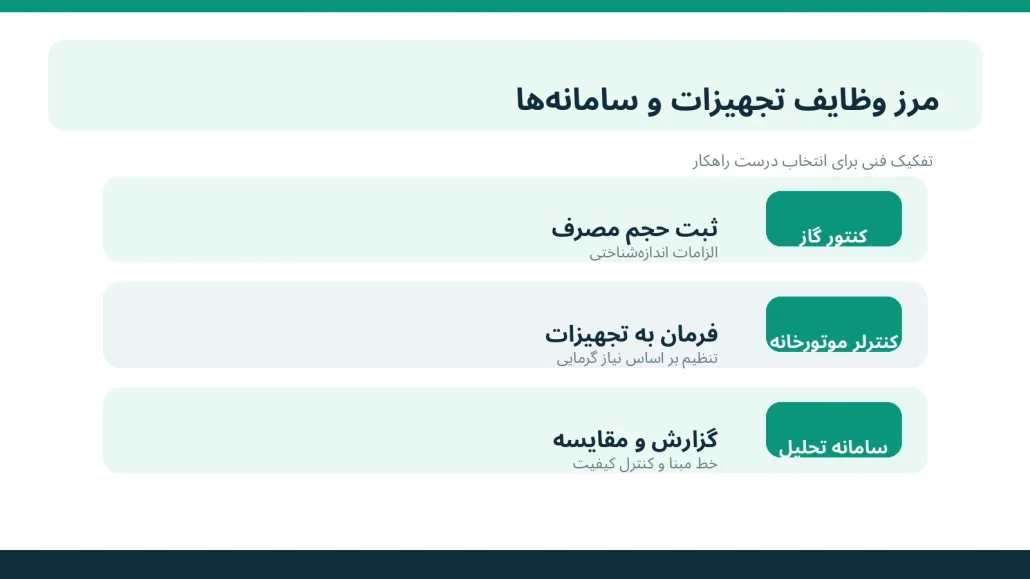
Three functions should be distinguished. A gas meter measures consumption volume. A boiler-room controller issues commands from defined inputs. An energy-monitoring system combines data for reporting and analysis. They may be integrated, but have different functions and evaluation criteria.
Does installing a smart gas meter alone save gas?
No. Measurement or remote reading does not physically improve burner efficiency, pipe insulation or operating schedules. Reliable data can reveal high consumption and demonstrate corrective results, but savings require appropriate decisions and implementation. Smart meters also differ in communications and analytical capabilities; each model must be assessed separately.
Start with an audit before buying equipment
Document existing conditions first. An incorrect schedule, failed sensor, water-circuit leak or deteriorated insulation may affect consumption. Without diagnosis, new equipment could be installed while the main problem remains.
- Building record: use, floor area, units, occupancy hours and independently heated sections.
- Plant record: boiler, burner, pump and controller types, installation dates, servicing and drawings.
- Consumption history: readings, bills, closures and changes in use.
- Comfort: temperatures in selected spaces and reports of underheating or overheating.
- Safety: qualified inspection of flues, ventilation, connections and combustion equipment.
An audit should prioritise improvements by cost, risk and measurability. Schedule corrections may be inexpensive, but unqualified personnel must not adjust burners, gas valves or combustion systems.
The meter’s role in evaluating boiler-room performance
The meter begins measurement at a defined boundary. If one meter also serves an industrial kitchen or other equipment, a change cannot be attributed directly to the boiler room. Define the boundary or use a valid method to estimate other uses separately.
Data quality comes first
Record meter number, volume unit, reading date and time, period and any replacement or failure. Comparing different periods without equalising duration and assessing reading quality may mislead. Remote systems also need checks for communications gaps, duplicates and inconsistent clocks.
Applicable standards, legal requirements, accuracy checks and installation conditions matter more than a digital appearance or software features. Ekbatan Gas Control can explain the importance of trustworthy measurement without attributing unverified functionality to a particular product.
Four stages of a measurable programme
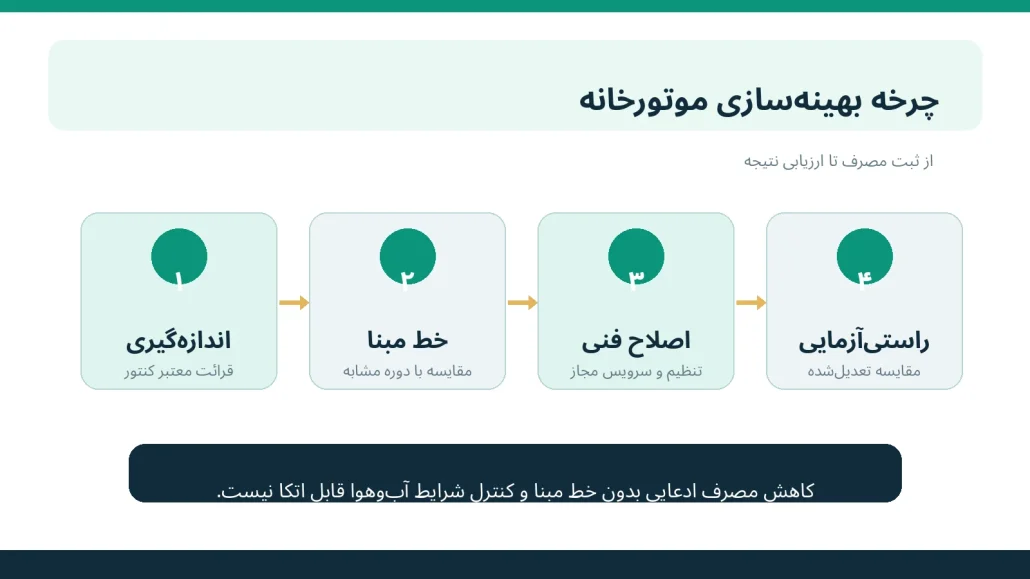
1٫ Define the baseline
A baseline documents pre-improvement consumption. Comparable months from a previous year may help, but account for staff numbers, working hours, weather and building-use changes. Regular data and representative periods improve reliability.
2٫ Choose suitable corrective measures
Options include proper servicing, control adjustments, insulation, operating schedules and, when technically justified, a controller. Select after a site survey: schools, hospitals, factories and residential complexes need different solutions. In sensitive buildings, continuity of heating and operating requirements take priority over consumption targets.
3٫ Record changes and commission safely
Record each implementation date, settings before and after, responsible specialist and test report. Simultaneous changes make individual contributions harder to separate. Commissioning must assess safe operation, ventilation, flue discharge and heating quality. A lower meter reading alone does not prove complete success.
4٫ Verify savings
Compare measured consumption against an adjusted baseline. A warmer winter may explain reduced use independently of smart control. Outdoor temperature, heating degree days and operating hours can support a fairer comparison. The calculation method must suit the available data and project objective.
An apparent reduction is not necessarily verified savings
Suppose a hypothetical building uses 12,000 m³ in the baseline period and 9,900 m³ after improvements. The simple difference is 2,100 m³, or 17.5%. This describes two readings. If the second period is shorter, warmer or includes more closures, the full 17.5% cannot be attributed to the project without adjustment.
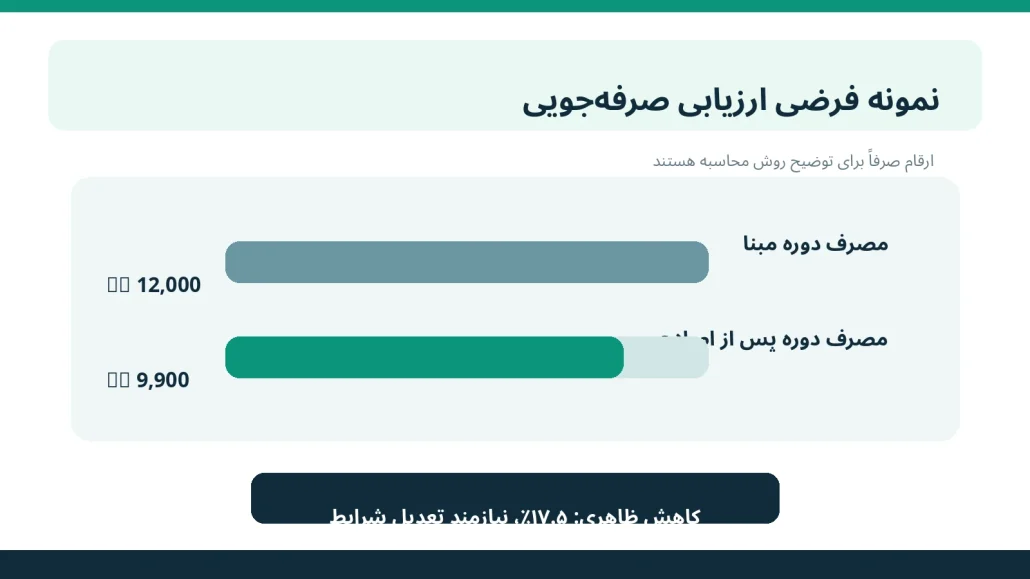
| Indicator | Before, hypothetical | After, hypothetical |
|---|---|---|
| Recorded consumption | 12,000 m³ | 9,900 m³ |
| Simple difference | — | 2,100 m³ |
| Simple percentage difference | — | 17٫5% |
| Savings verification | Requires a baseline | Requires adjustments and assessment |
If payment depends on savings, agree the method, data sources, adjustment rules, uncertainty limits and verification responsibility in advance. Bill differences without a defined measurement and verification method are insufficient for many contractual decisions.
A pre-winter checklist for building managers
| Topic | Check | Suggested responsibility |
|---|---|---|
| Meter and readings | Are number and dates recorded? | Building or energy manager |
| Boiler room | Have servicing and safety tests been completed? | Authorised heating specialist |
| Heating controls | Are occupancy and holiday schedules defined? | Operations manager |
| Comfort | Are temperatures and complaints monitored? | Maintenance staff |
| Consumption reporting | Is comparison adjusted for baseline and weather? | Energy specialist |
This checklist clarifies responsibilities and does not replace specialist regulations. Managers can arrange visits and records but should not personally alter combustion settings or gas connections. Gas leaks, flue defects and ventilation problems must follow official safety procedures and the responsible authorities’ instructions.
Questions for suppliers
The word “smart” is insufficient. For meters and monitoring, check flow range, metrological class or requirements, installation, reading interval and method, storage, report extraction and security. For controllers, check compatibility with the existing boiler and burner, power or sensor failure behaviour, permitted manual operation and support.
Request separate specifications for measurement equipment, communications and the controller. If one system performs several functions, require evidence for each. Service contracts should define missing-data handling and responsibility for repair or calibration.
Ekbatan Gas Control in the consumption management chain
Meter manufacturers contribute to measurement and reliable consumption data. These data support high-use trend detection, efficiency project assessment and management reporting. Actual reductions result from engineering, behavioural and management measures, rather than a meter alone.
For any Ekbatan model, review its own specifications and approvals. This article makes no model-specific claim about remote control or leak detection. Official company information is available on Ekbatan Gas Control’s website.
Lasting savings begin with reliable data
Smart control is useful when existing conditions are assessed before installation and results are verified afterwards. Accurate records, proper servicing, suitable operating schedules and attention to comfort and safety form a practical foundation. A gas meter is thus both a billing instrument and a data source supporting better energy decisions.
Sources and limits
Sources are Tasnim’s South Khorasan report of 21 Shahrivar 1405 and Mize Energy’s Isfahan report of 25 Khordad 1405, linked above. Figures belong to those dates. The numerical example and all illustrations are hypothetical educational material. The original guide was prepared on 22 Mehr 1405 and is not breaking news.
Frequently asked questions
How much gas can smart boiler-room control save?
There is no universal percentage. Results depend on initial condition, building use, climate, working hours, control design and verification.
Does a smart gas meter control the boiler room?
Not necessarily. The meter measures; control requires suitable control equipment and systems.
How can a consumption reduction be measured?
Use reliable before-and-after readings, a defined boundary and adjustments for influences such as temperature and operating hours.
Does a lower bill mean a lower gas volume?
No. Tariffs, period length and other conditions can change the bill. Technical evaluation needs volume and comparable conditions.
Who should adjust burners and gas appliances?
Only qualified people following manufacturer instructions and safety rules. Managers should not intervene in combustion equipment or gas connections.
Do provincial reports establish smart capabilities in all Ekbatan meters?
No. They concern provincial boiler-room programmes and do not verify any particular Ekbatan model’s features.