
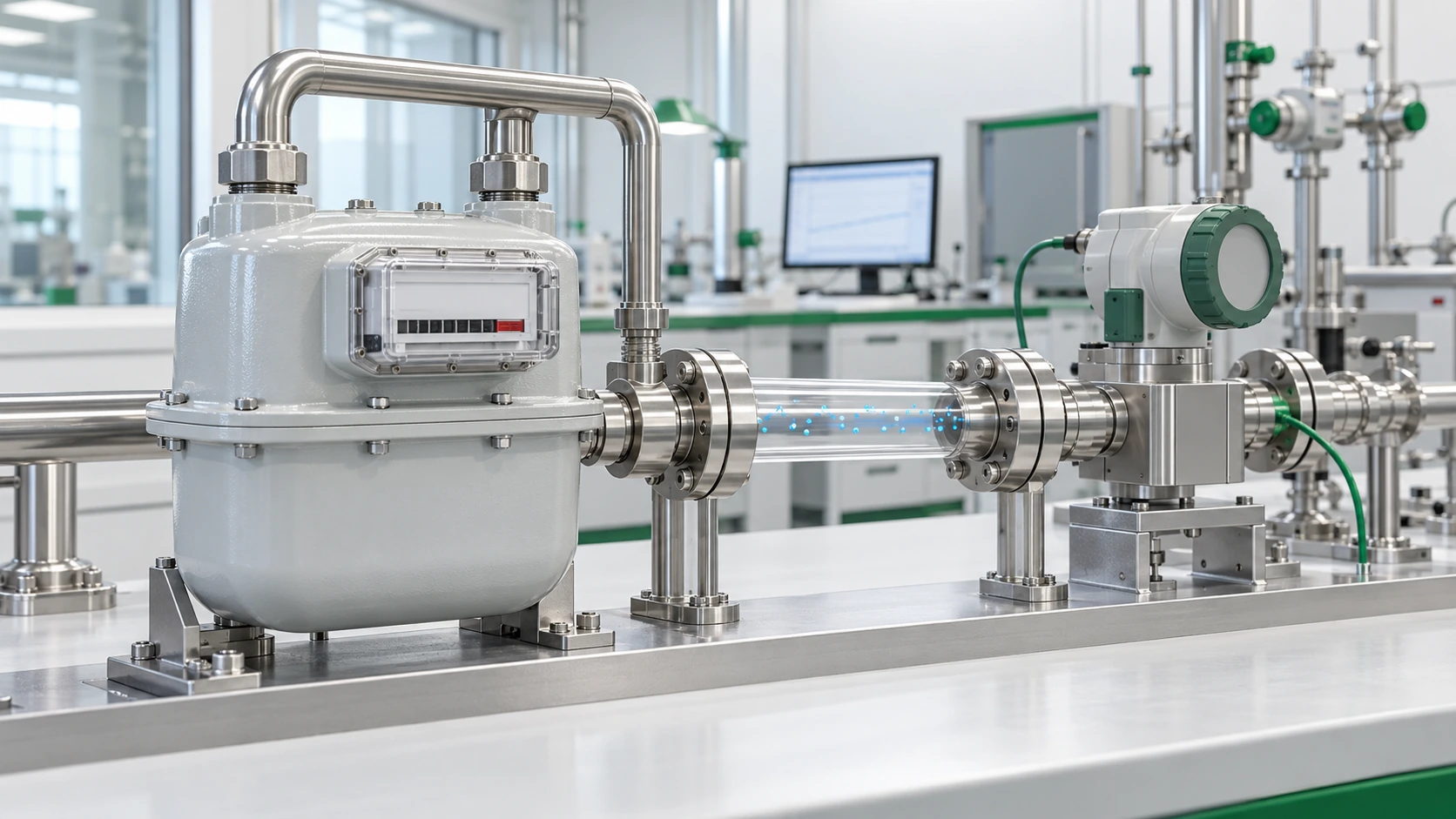
A gas meter must perform reliably not only at high flow but also when gas demand is low and intermittent. A small burner, a modulating boiler or an appliance running at partial load can keep the flow far below a meter’s maximum rating. That is why a residential gas meter should never be selected by maximum capacity alone. Three values—Qmin, Qt and Qmax—describe its rated flow range and help engineers interpret metrological performance.
This is an educational explanation, not a test report for any particular meter. It draws on OIML R 137-1&2:2012 and the scope of EN 1359:2017 for diaphragm gas meters. Neither reference, by itself, proves compliance with Iranian regulations or certifies a product sold by Ekbatan Gas Control. Model-specific declarations, approvals and test documentation must be checked separately.
What do Qmin, Qt and Qmax mean on a gas meter?
Qmax is the declared maximum gas flow rate within the meter's rated operating range. Qmin is the declared minimum flow at which the applicable metrological requirements must still be met under specified conditions. Qt, the transitional flow rate, divides the range into a lower and an upper zone, potentially subject to different maximum permissible errors. Flow rates are commonly expressed in cubic metres per hour (m³/h).
Why does the transitional flow rate matter?
A meter that performs well close to Qmax is not automatically equally accurate close to Qmin. Mechanical friction, sensor sensitivity, flow conditions and the measuring principle can affect the error curve. Qt provides a boundary between metrological zones. One successful test point cannot establish accuracy across the entire measuring range, particularly where consumption repeatedly approaches the lower end.
How is low-flow gas meter error calculated?
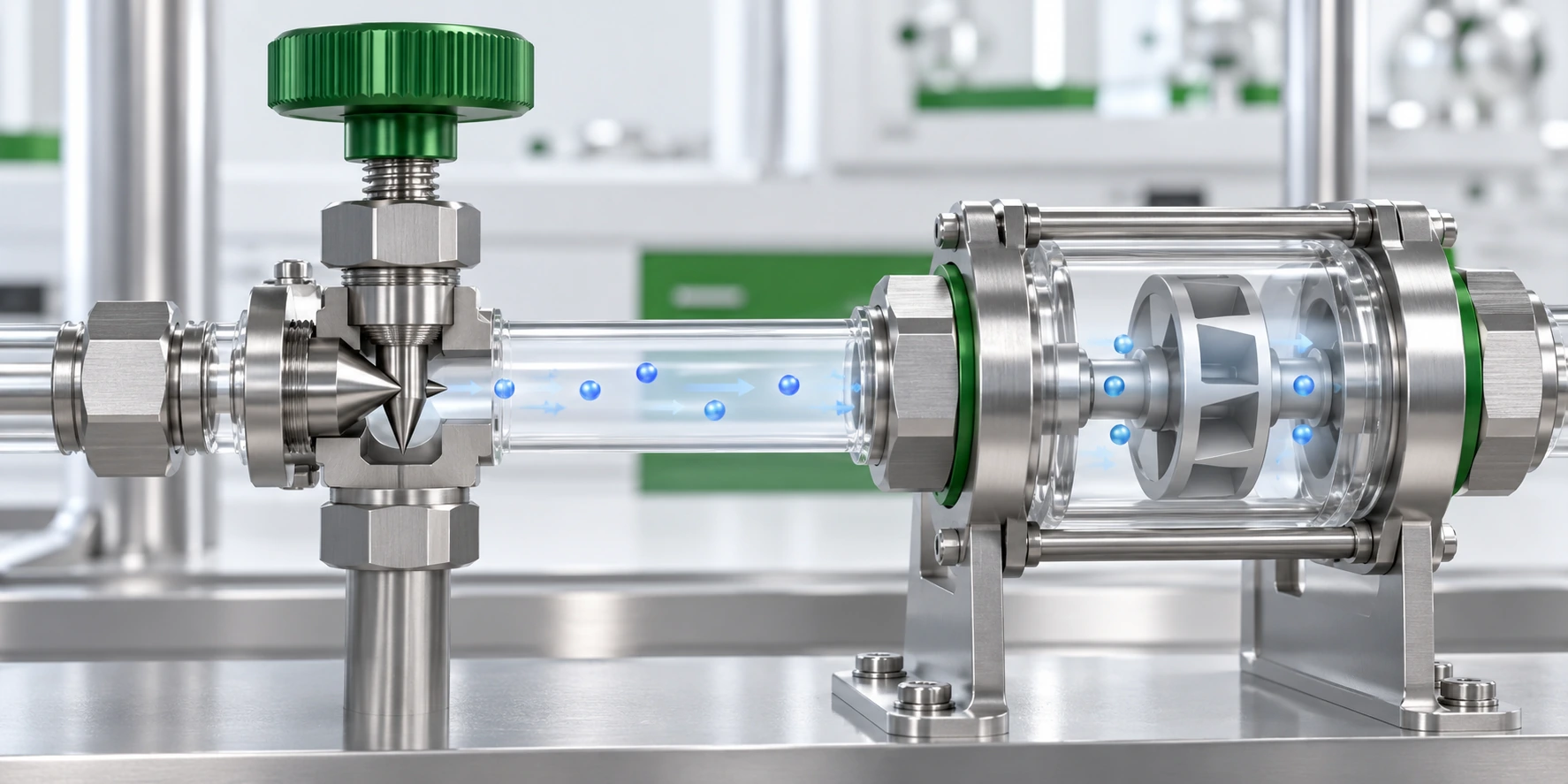
In a volume test, the indicated volume is compared with a reference volume measured by a traceable test system. A common expression is E = ((Vmeter − Vref) / Vref) × 100%. Positive error means the meter indicates more than the reference; negative error means it indicates less. Both quantities must first refer to comparable measurement conditions, otherwise the calculation may mix unlike volumes.
For a purely illustrative example, a reference volume of 10.00 m³ and a meter indication of 9.80 m³ give an error of −2%. This is not a measured result for any Ekbatan product. Whether such an error is acceptable depends on the accuracy class, the flow-rate zone, the verification stage and the applicable regulatory requirements.
Maximum permissible error is not a universal number
For accuracy class 1.5, OIML R 137-1&2:2012 gives initial type-evaluation and verification limits of ±3% from Qmin to below Qt and ±1٫5% from Qt through Qmax. These values should not be transferred automatically to every installed meter or in-service inspection. The standard's scope, edition, test conditions and any national legal-metrology rules remain decisive.
| Parameter | Meaning | Common mistake |
|---|---|---|
| Qmin | Minimum declared flow | Assuming guaranteed accuracy below Qmin |
| Qt | Boundary between lower and upper error zones | Confusing Qt with Qmax |
| Qmax | Maximum flow within the rated range | Sizing by Qmax alone |
| Class 1.5 in OIML R 137 (initial tests) | ±3% below Qt; ±1٫5% from Qt to Qmax | Applying these limits to every meter and in-service test |
G2.5 versus G4: how should the meter size be chosen?
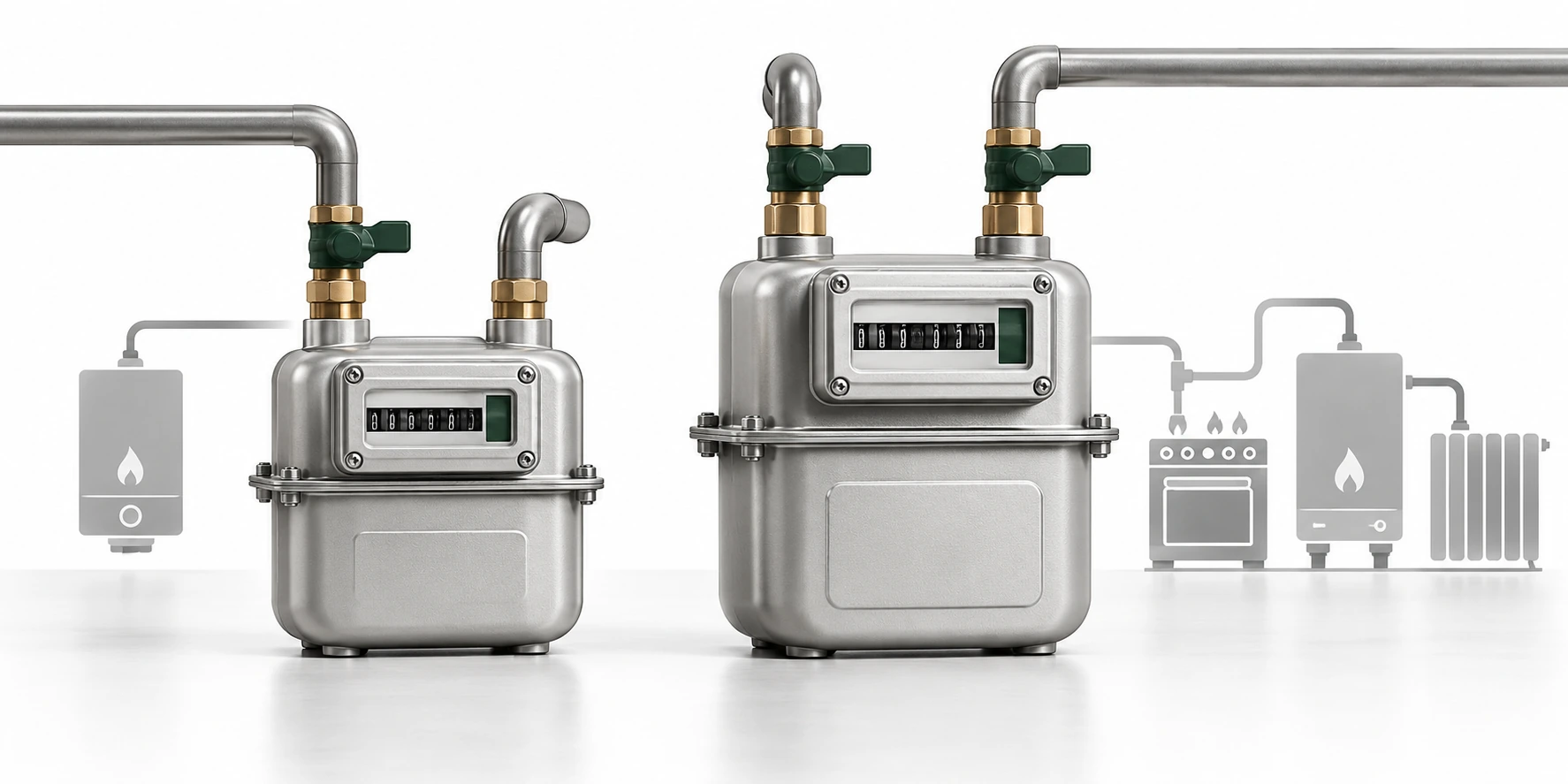
G2.5 and G4 are familiar gas meter size or capacity designations, not complete performance specifications. G4 diaphragm models are commonly intended for higher flow demand than G2.5 models, but the actual Qmax, Qmin, pressure loss, operating pressure and temperature limits must be taken from the specific meter's nameplate and technical data sheet. Assuming identical numerical ratings across all manufacturers and product variants can lead to a poor selection.
Oversizing is not automatically safer
A meter that cannot accommodate the maximum simultaneous demand is unsuitable. Yet selecting a substantially larger meter without reviewing low-load performance is not automatically a better solution. Designers should assess the realistic simultaneous appliance load, minimum operating flow, allowable pressure drop, gas characteristics and utility requirements. A building's apartment count alone is not a substitute for an approved load calculation.
What does a gas meter test laboratory actually check?
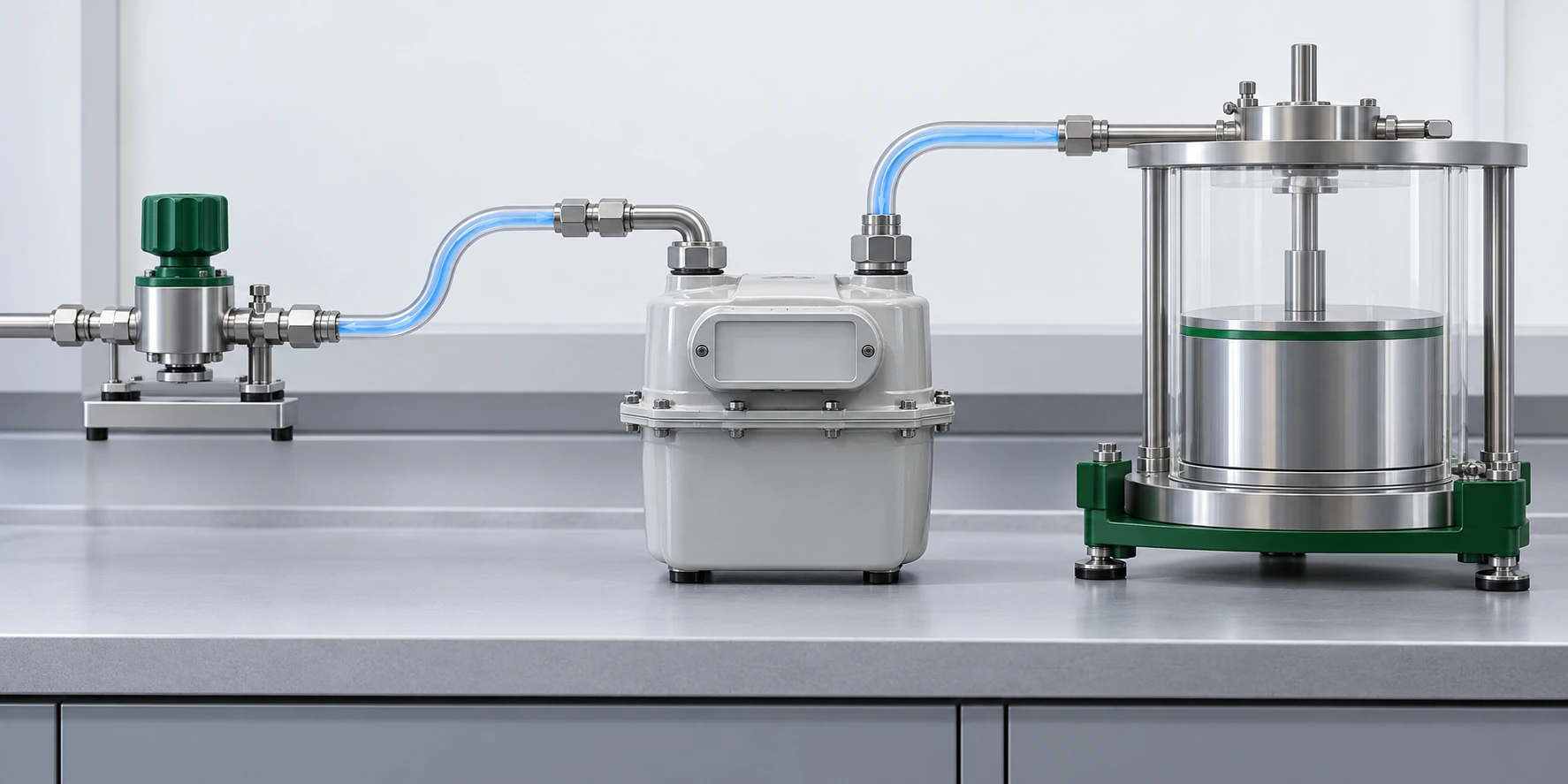
A defensible test involves much more than reading a mechanical index or digital display. Reference-system traceability, stable flow, pressure and temperature, installation conditions, repeated readings and measurement uncertainty must be documented. EN 1359:2017 addresses construction, performance and testing of diaphragm meters within its defined scope; different meter technologies may require other standards. Test points and procedures must follow the applicable approved method.
Measurement error, uncertainty and malfunction are different
Error is the difference between the meter's result and a reference result. Uncertainty describes the remaining doubt around a measurement result. A seemingly small error, without the uncertainty and test conditions, does not establish conformity. Mechanical damage, gas leakage and tamper evidence are separate safety or integrity concerns; they should be handled under authorised inspection procedures, not inferred from a volume-error formula alone.
Does a smart gas meter solve low-flow accuracy problems?
A smart gas meter may record interval data, transmit readings and report selected events or alarms. However, adding a communication module does not automatically improve Qmin, the error curve or the meter's accuracy class. Metrological performance and digital functionality require separate evaluation. An upgraded gas meter is not necessarily based on a new measurement principle; whether its lower-flow capability changes depends on the actual product architecture.
What can consumption data tell an operator?
Consumption profiles can help identify changing demand patterns, examine low-load periods and plan field service. But a leakage or tampering diagnosis requires validated algorithms, appropriate thresholds and, where necessary, on-site investigation. A zero interval reading alone does not prove that no physical flow occurred or that the meter is fault-free. Smart gas network data must be interpreted alongside communication status, data quality and sensor limitations.
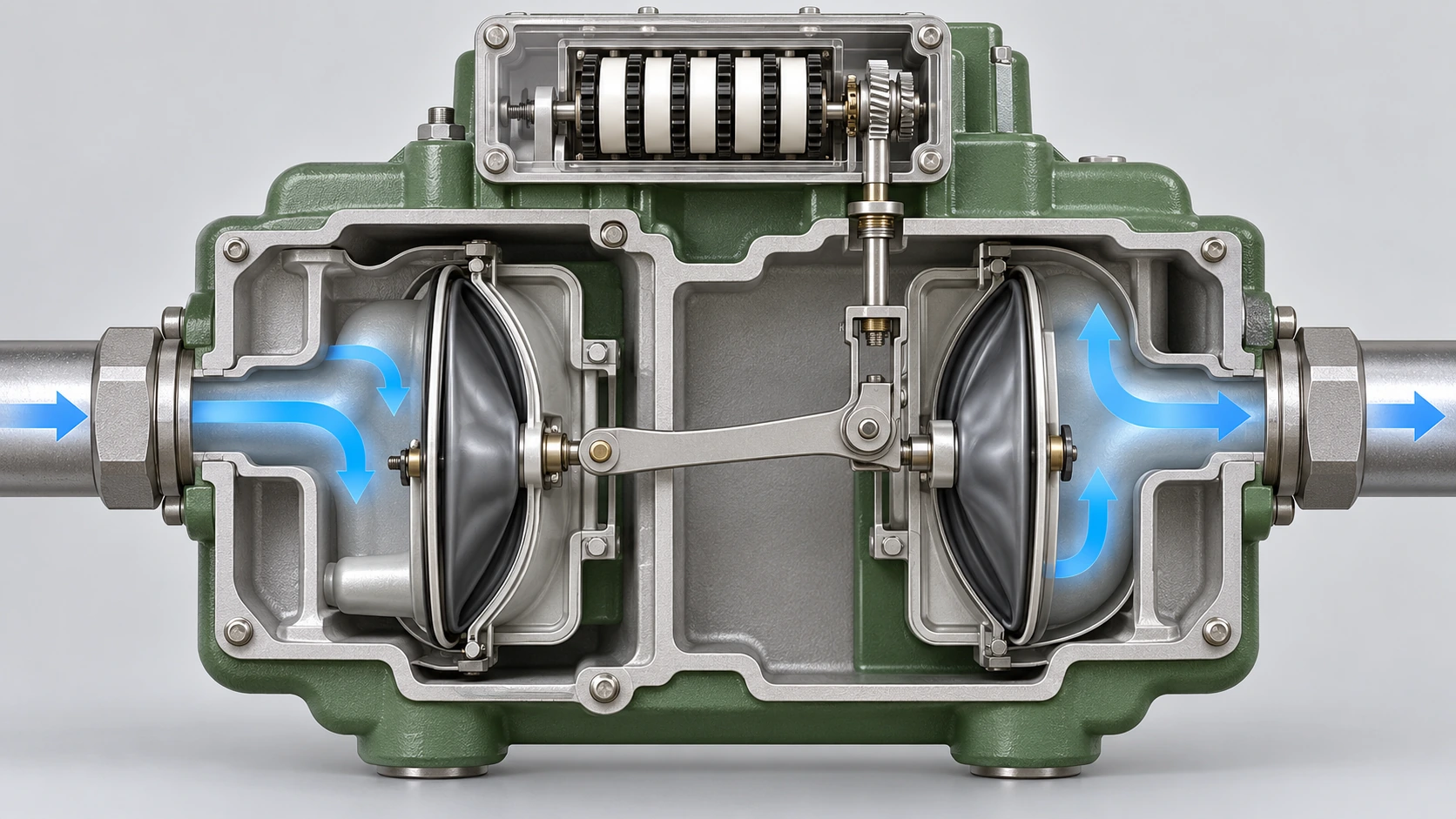
A practical purchasing checklist for residential gas meters
When specifying a G2.5 or G4 gas meter, document the expected maximum and minimum flow first. Then compare the model's declared Qmin, Qt and Qmax with the load profile. Review accuracy class, operating pressure and temperature, pressure drop, connections, installation constraints, valid approvals and service arrangements. If remote reading is needed, evaluate the communication protocol, data security, battery life and system interoperability separately from the metrological characteristics.
Shared responsibility across the gas supply chain
Manufacturers should provide clear technical specifications and the appropriate test documentation. Designers and gas network operators must ensure correct sizing, compliant installation and maintenance within rated limits. Ekbatan Gas Control operates in the gas equipment sector, but this article makes no claim about a particular Ekbatan meter's measured accuracy, certification status or flow-range figures.
Key takeaways
Qmin, Qt and Qmax frame the essential question: can a meter measure the entire expected consumption range with acceptable performance under its rated conditions? Comparing G2.5 and G4 only makes sense alongside model-specific ratings, the error curve, accuracy class and actual demand. Sound metering starts with selection and continues through traceable testing, correct installation and maintenance.
References and limitations
Reference 1: OIML R 137-1&2:2012, Gas meters—flow-rate definitions and metrological requirements: https://www.oiml.org/en/files/pdf_r/r137-1-2-e12.pdf
Reference 2: EN 1359:2017, Gas meters—Diaphragm gas meters—scope and testing requirements: https://www.sis.se/en/produkter/construction-materials-and-building/installations-in-buildings/gas-supply-systems/ss-en-13592017/
These references explain general engineering principles; they are not evidence of product certification or specific legal requirements in Iran.