
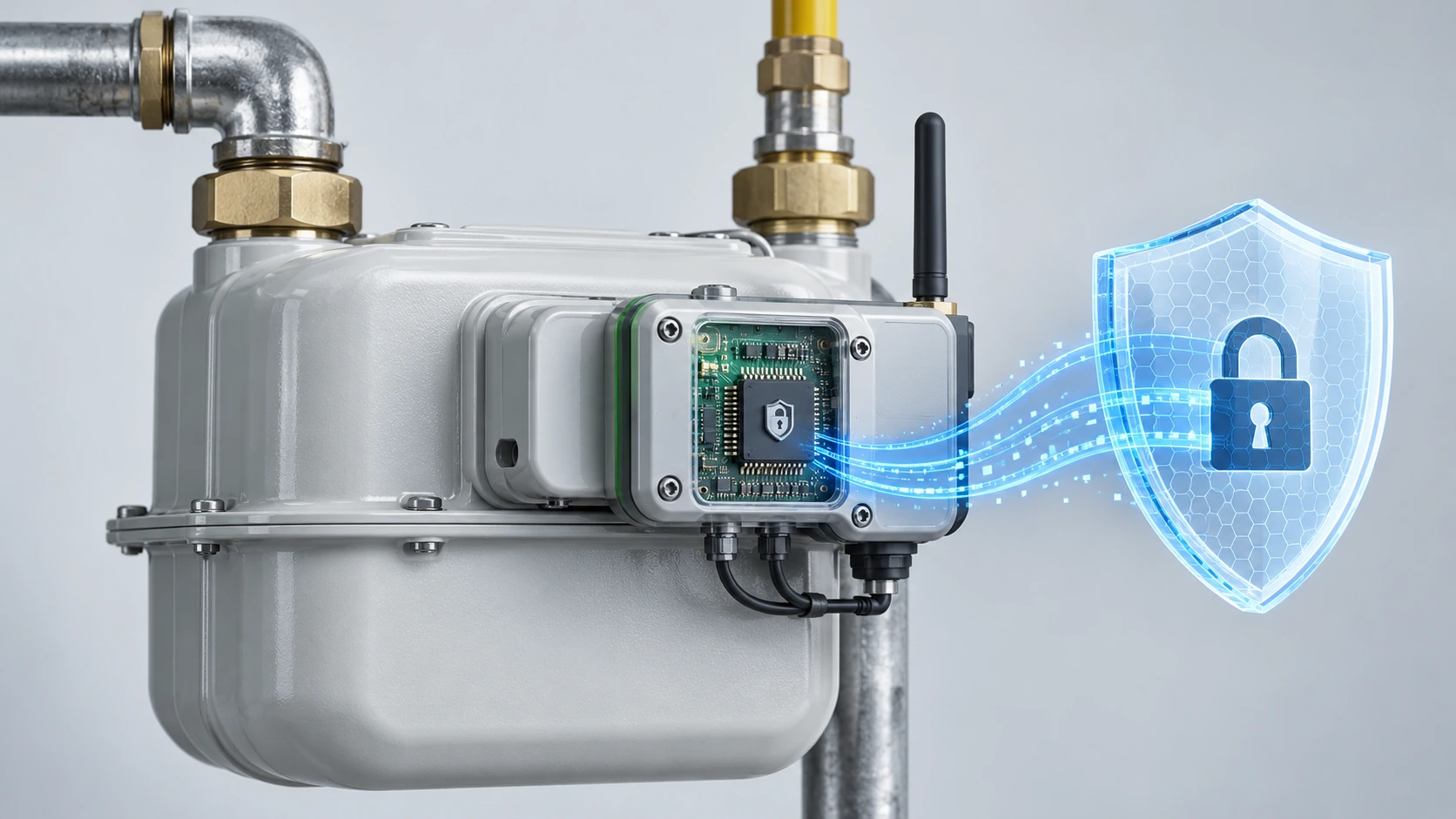
A smart gas meter is more than a device that displays consumption. Once remote reading, communications and software management are introduced, data protection and access control become part of the overall quality of the metering system. A sound architecture should protect customer information, prevent unauthorized changes to readings and preserve the availability of essential services.
This educational guide is intended for gas utilities, equipment manufacturers, integrators and procurement teams. It does not claim that any specific EGC gas meter or competing product includes a particular security feature. Product capabilities must be established from model-specific documentation, test evidence and the utility’s requirements.
Where are the cybersecurity boundaries in a smart gas meter?
Understanding the trust boundary
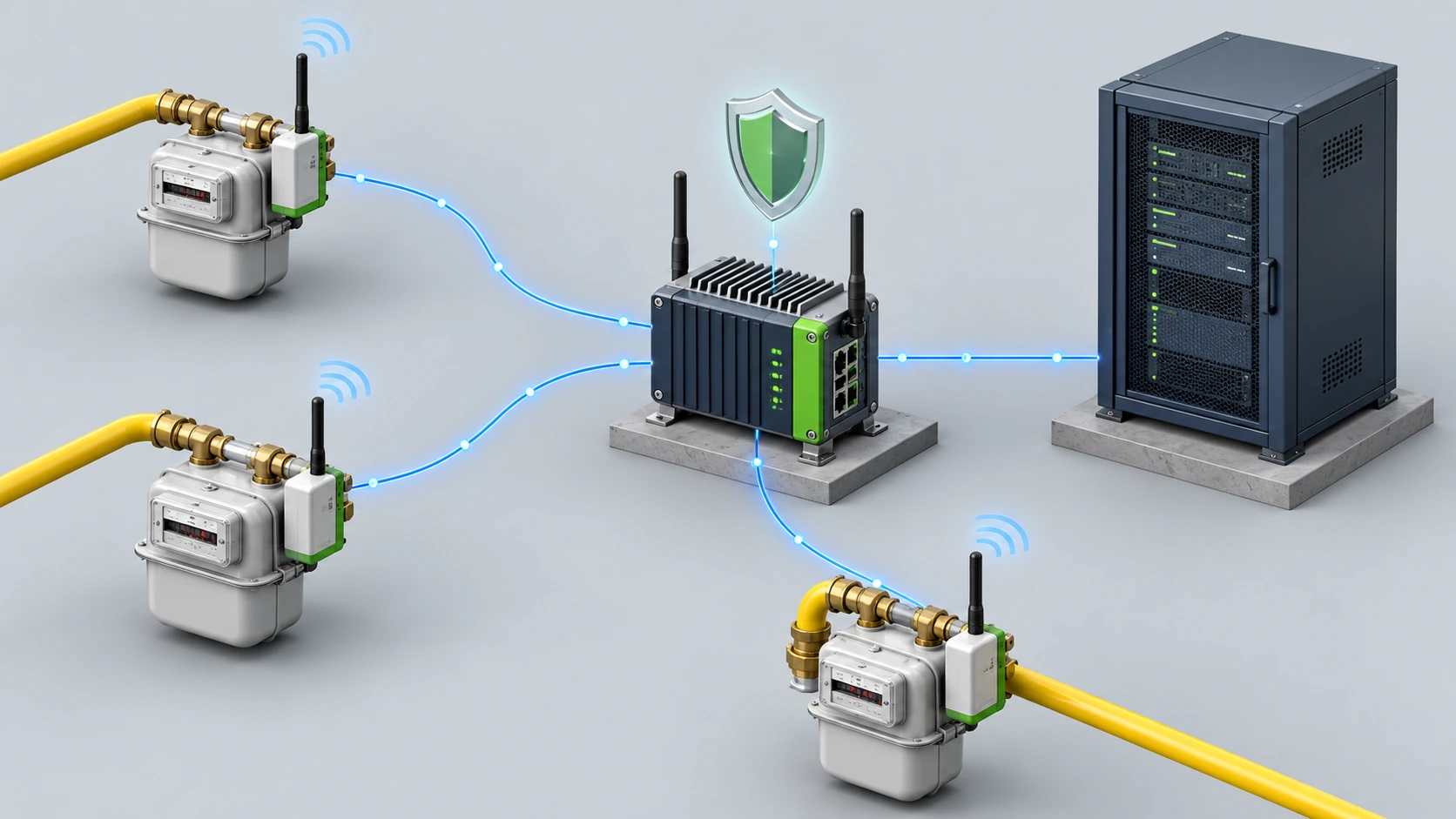
A remote metering architecture may include a measuring mechanism, an electronic register, a communications module, a network, a data concentrator and a head-end system. Some projects combine several functions in one enclosure; others distribute them across devices and services. Each interface enables data exchange, but it also creates a boundary that deserves a risk assessment.
A trust boundary defines which component may read data, issue commands, change settings or install software. Network connectivity must not automatically confer permission to alter legally relevant metrological parameters. Roles, privileges and separation of duties should be designed before the system is deployed.
The three objectives of metering-data protection
Confidentiality, integrity and availability
Confidentiality restricts unauthorized access to information. Fine-grained gas-consumption patterns may reveal aspects of household occupancy or operating schedules. Integrity means that readings, timestamps and device identifiers cannot be silently modified in transit or storage. Availability concerns the continued operation of the functions on which the utility depends.
These objectives need not carry identical weight in every subsystem. In gas infrastructure, cybersecurity controls must be evaluated alongside operational safety and reliability. A security change that disrupts metrology, legitimate maintenance or safety procedures is not a successful design.
Device authentication and cryptographic key management
Why fleet-wide shared secrets create risk
The head-end system needs a defensible way to establish which authorized device originated a message. Depending on the design, the meter may also need to authenticate the receiving service. Unique credentials and cryptographic authentication can support these checks; a printed serial number alone does not prove the sender’s identity.
If thousands of devices share one long-lived secret, compromise of that secret may affect a large portion of the fleet. A key-management policy should cover secure generation, provisioning, protected storage, rotation or replacement, revocation, event recording and decommissioning. NIST SP 800-57 provides general key-management guidance; actual algorithms and key sizes require system-specific assessment.

Securing AMR and AMI communications
Transport encryption is not the whole answer
Automatic Meter Reading (AMR) generally refers to automated collection of readings. Advanced Metering Infrastructure (AMI) can encompass broader two-way communications and management, although capabilities vary by project. Cellular or radio connectivity does not, by itself, establish application-message authenticity and integrity.
Security design should also consider replay protection, message sequencing, timestamp handling, error management and auditable events. An old reading retransmitted as a new one must not be accepted without appropriate checks. Protocol choices must account for battery life, device processing limits, operating conditions and the applicable utility architecture.
Secure firmware updates over the device lifecycle
Authenticity, recovery and traceability
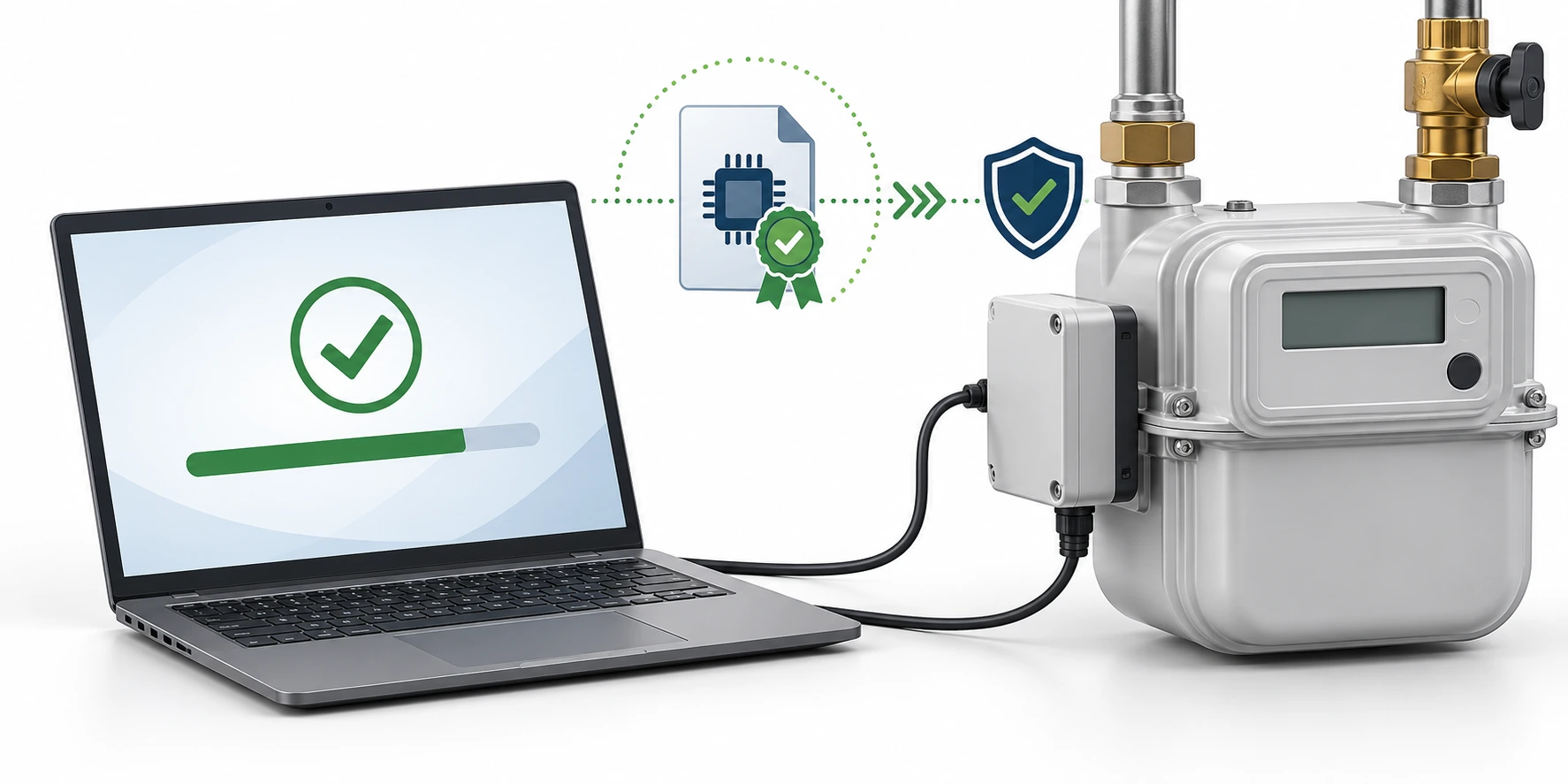
Connected equipment may need firmware maintenance to address defects and vulnerabilities. An update should come from an authorized source and be checked for authenticity and integrity before installation. Engineering review should address interrupted transfers, power loss, recovery to a trusted state and prevention of unauthorized or unsuitable versions.
OIML D 31:2019 discusses software identification, protection of legally relevant functions, evidence of intervention and controls around software changes in measuring instruments. Updating a communications stack must therefore not be treated as automatically harmless to legally relevant metrological software or parameters.
Event logs, tamper indicators and incident review
An alert is not proof of fraud
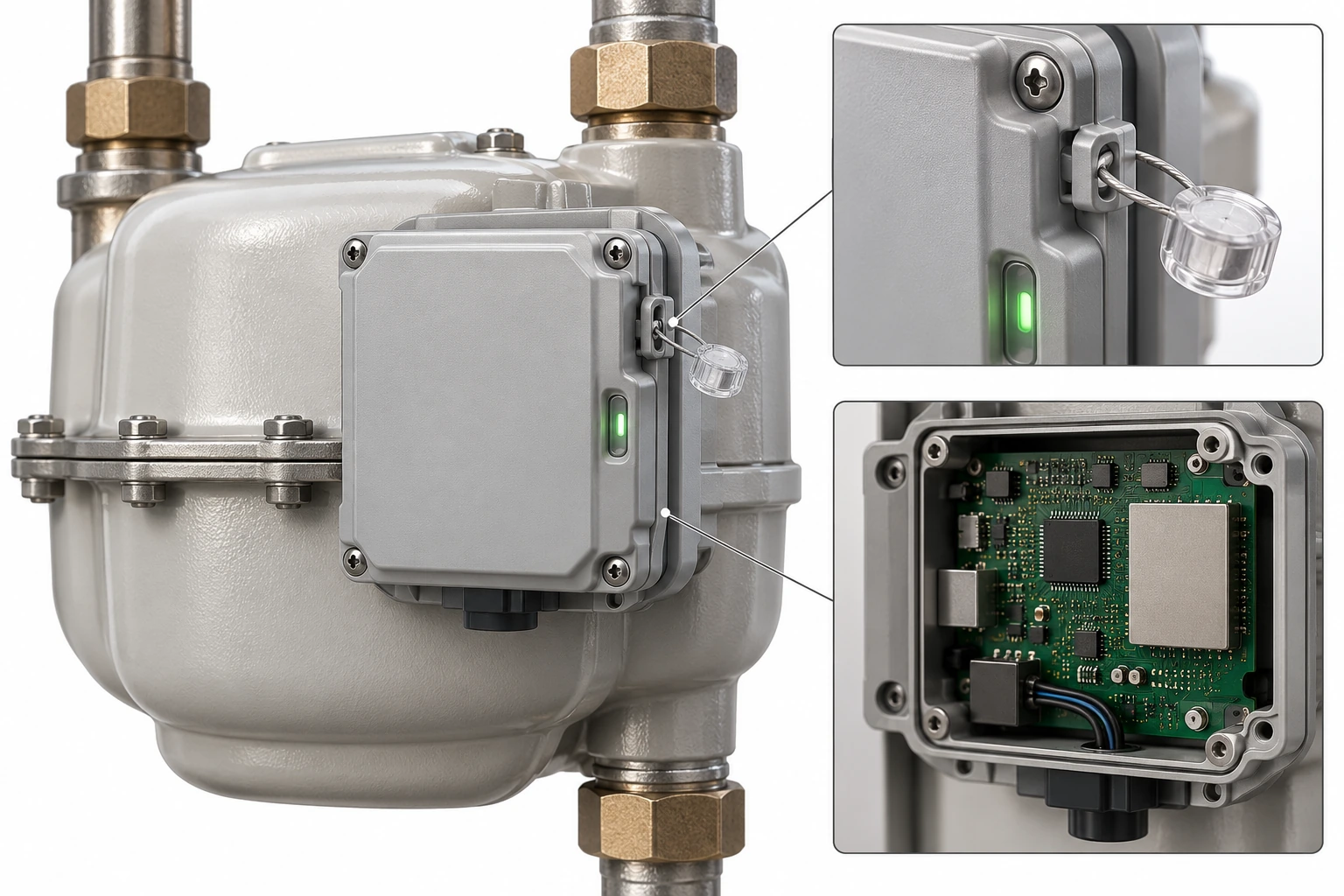
Useful events may include repeated failed logins, configuration changes, abnormal communications, firmware-version changes and enclosure opening where a suitable sensor exists. Logs are only useful when timestamps, device identifiers, retention rules and protection against alteration are trustworthy.
A tamper alert does not, on its own, prove deliberate interference, gas theft or metrological failure. Qualified personnel need additional evidence and the utility’s authorized procedures. Excessive collection or indefinite retention of detailed consumption and event data can create separate privacy risks.
Responsibilities across the supply chain
Security is not a chip specification
Manufacturers should document supported security functions, secure configuration, update procedures and product limitations. Utilities should define access roles, manage credentials, monitor incidents, maintain backups and track assets through retirement. Installation and service contractors should receive only the permissions necessary for their tasks, with changes traceable to authorized work.
A cryptographic chip or the word “secure” on a brochure does not demonstrate the security of an end-to-end deployment. Testing, vulnerability handling, workforce training and post-installation support matter as much as hardware features. NIST SP 800-82 Rev. 3 emphasizes OT controls that respect operational safety and reliability.
A practical procurement checklist
Evidence to request before buying
Procurement documents should state which data are collected, where they are stored, who can access them and how the system behaves during communications outages. They should request verifiable evidence for authentication, key management, message protection, updates, logging and secure retirement.
IEC 62443-4-2 sets out technical security requirements for components of industrial automation and control systems. Its relevance depends on the architecture and procurement scope; merely mentioning the standard does not certify a gas meter or establish that it is legally mandatory in Iran.
| Assessment area | Question to ask | Evidence to request |
|---|---|---|
| Device identity | Are devices and services authenticated appropriately? | Design description and test results |
| Message integrity | How are altered or replayed messages detected? | Protocol specification and integrity tests |
| Key lifecycle | How are keys issued, replaced and revoked? | Key-management policy |
| Firmware updates | Are packages verified and failures recoverable? | Update test plan and version records |
| Event logging | Which events are recorded and protected? | Sample logs and retention policy |
| Retirement | How are credentials and data handled at end of life? | Decommissioning procedure |
Cybersecurity is not metrological accuracy
What gas-sector decision makers should conclude
A meter may meet applicable metrological accuracy requirements while still having weaknesses in network access control. The reverse is also possible: strong communications security does not establish measurement accuracy. Connected meters need two distinct but coordinated assessments—metrological conformity and lifecycle cybersecurity.
For gas utilities and manufacturers, a defensible program starts with clear requirements, testable controls, assigned responsibilities and maintainable documentation. The objective is to manage risk throughout the equipment lifecycle, not to promise absolute security or claim undocumented features for any particular product.
Sources and limits of applicability
Reference 1: NIST SP 800-82 Rev. 3, Guide to Operational Technology Security (2023): https://www.nist.gov/publications/guide-operational-technology-ot-security
Reference 2: OIML D 31:2019, General Requirements for Software-Controlled Measuring Instruments: https://www.oiml.org/en/files/pdf_d/d031-e19.pdf
Reference 3: NIST SP 800-57 Part 1 Rev. 5, Key Management Guidance (2020): https://csrc.nist.gov/pubs/sp/800/57/pt1/r5/final
Reference 4: IEC 62443-4-2:2019, Component Security Requirements for Industrial Control Systems: https://webstore.iec.ch/en/publication/34421
These documents explain general engineering principles; they are not evidence of EGC product certification, specific Iranian legal obligations or implementation in any named model.